
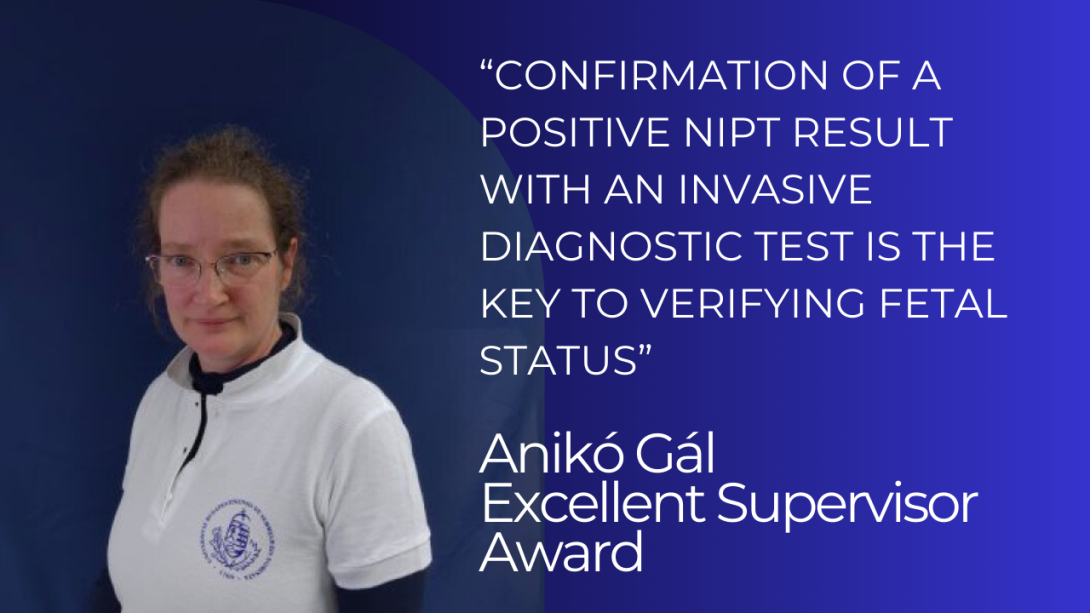
Her student has recently published his findings in the D1 journal American Journal of Obstetrics and Gynecology, and is set to defend his Ph.D. thesis this spring. Their discoveries could help increase the effectiveness of genetic tests. Anikó Gál was honored with the Excellent Supervisor Award by the Centre for Translational Medicine.
Anikó Gál works at Semmelweis University as a molecular biologist and geneticist, and is the head of the laboratory of the Institute of Genomic Medicine and Rare Disorders. She also participates in the work of Czeizel Institute. At the university, she supervises six Ph.D. students, one of whom is about to obtain his doctorate at CTM. „I joined the Centre for Translational Medicine as a supervisor at the invitation of Professor Szabolcs Várbíró. The program caught my interest because I knew that students at CTM would receive significant assistance in conducting meta-analyses from statisticians and scientific methodology supervisors,” she says.
At CTM, Anikó Gál's Ph.D. student is Márton Kónya, who has investigated the accuracy of non-invasive prenatal testing for rare chromosome abnormalities. In his research, he has also examined the background of false positive results. „These tests received a lot of criticism after their release, and I was also skeptical about them because it was unclear how reliable their results were. We investigated this question in Márton's first meta-analysis, which was published in Plos One. Our study was the first meta-analysis to examine Genome-Wide Non-Invasive Prenatal Testing test results for individual chromosomes,” she says. The research revealed that screening with GW-NIPT can help in the early detection of rare chromosomal abnormalities. It also turned out that GW-NIPT shows a minimal increase in the false positive rate but can detect all chromosomal abnormalities with mutations above the detection limit. For this reason, confirmation of a positive NIPT result with an invasive diagnostic test is key to verifying fetal status.
After their first project, the researchers began to investigate what might be behind the false positive results and what they might predict. Their meta-analysis, published in the American Journal of Obstetrics and Gynecology, revealed that discordant genome-wide noninvasive prenatal testing results are associated with an increased risk of placenta-mediated complications. In such cases, the incidence of adverse pregnancy outcomes is higher than in the general population. The meta-analysis also showed that complex, multichromosomal genome-wide noninvasive prenatal testing results are occasionally associated with maternal malignancies. For this reason, maternal oncology-hematology consultation is recommended to rule out occult malignancy. Anikó Gál emphasizes that NIPT-based risk assessment is important from both a social and preventive perspective. “Although NIPT is not currently available through public funding in Hungary, based on our data, statistical estimates suggest that approximately 180-200 pregnancies per year are likely to be positive for autosomal trisomy. Thirty-five percent of these cases are associated with unwanted pregnancy outcomes, such as intrauterine growth retardation, preeclampsia, premature birth, and stillbirth. As these are potentially high-risk pregnancies, they can be identified at an early stage with a more widespread NIPT test, and serious consequences could be prevented with targeted follow-up.
(Szabó Emese)