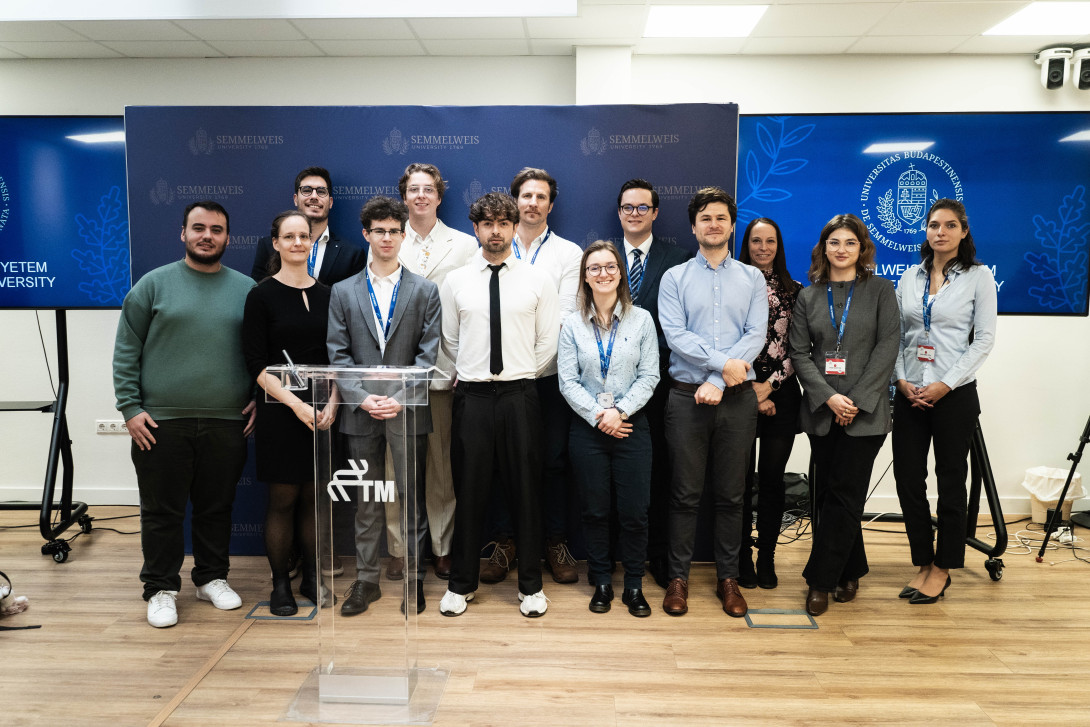
Seventy-nine first-year Ph.D. students delivered presentations at the 3-month Progress Report of the Centre for Translational Medicine in December. Among them were specialists and residents, medical doctors and dentists, pharmacists, psychologists, physiotherapists, clinical dietitians, and other healthcare professionals. In addition to more than forty domestic Ph.D. students, twelve students arrived from the Medical University of Vienna. The students' reports showed that they have made good progress with their research and have excellent presentation skills.
In December, the Center for Translational Medicine held the 3-Month Progress Report for the first-year Ph.D. students. During the three-day event, a total of seventy-nine healthcare professionals reported on the progress of their research. The Ph.D. students presenting their work included internists, otolaryngologists, general surgeons, pediatricians, intensive care specialists, oncologists, rehabilitation physicians, gynecologists, fetal medicine specialists, and dentists. Among the presenters, there were a large number of residents from a wide variety of fields. They included residents in urology, radiology, interventional radiology, traumatology, pediatrics, surgery, pulmonology, gastroenterology, gynecology, anesthesiology, and intensive care. Among the Ph.D. students were medical doctors and MD-Ph.D. students, as well as pharmacists, psychologists, and other healthcare professionals.
Most of the domestic Ph.D. students came from clinics of Semmelweis University, but some were from the University of Szeged. There were also students who came from Bajcsy-Zsilinszky Hospital, Heim Pál National Children's Hospital, Jász-Nagykun-Szolnok County Hospital, and Somogy County Kaposi Mór Teaching Hospital. Most of the international students came from Austria, the Medical University of Vienna, but there were also several from Romania, Jordan, Israel, Poland, Germany, Iran, and China. The diverse background of the students is reflected in the fact that they come from a total of twenty countries.
Gynecology & Urology
Before the Ph.D. students' presentations, Year 1 Coordinator Jimin Lee gave an opening speech on the Progress Report – this was the routine for all three days of the event. The first day of the Progress Report began with the presentations given by the members of the Gynecology & Urology Group. The twenty-two students of this group are researching a wide variety of gynecological and urological topics. For example, one student is investigating the diagnostic accuracy of noninvasive prenatal tests in the detection of DiGeorge syndrome, while another is researching maternal metabolic conditions as a risk factor for ASD and ADHD in offspring. Another student is investigating the effect of maternal gonorrhea on pregnancy and neonatal outcomes. The urological topics were also varied. For example, one study is investigating the diagnostic accuracy of new biomarkers compared to PSA in prostate cancer screening, while another is examining the predictive value of clinical and pathological features for positive lymph nodes in prostate cancer patients who are PSMA PET negative.
Following the students from the Gynecology & Urology Group, seven members of the Critical Care Group reported on their progress. Their topics were also varied. One student, for example, is investigating the efficacy and safety of sodium bicarbonate supplementation in severe metabolic acidosis in critically ill patients, while another is examining the effectiveness and safety of intraoperative diuretics in kidney transplantation. Another interesting project is investigating the effects of total intravenous anesthesia on postoperative cognitive function in neurosurgery.
Miscellaneous, Gastroenterology, Pediatrics
The second day of the Progress Report started with the presentations of twelve members of the Miscellaneous Group. Some students of this group are conducting research on dermatology. One of them, for example, is investigating the efficacy and safety of targeted modulation of the gut microbiome in psoriasis. The group also includes students researching topics related to psychology and psychiatry. They have a project, for instance, that is investigating the effect of depression and anxiety on clinical outcomes in pancreatic cancer. The group also has a topic on pulmonology. The related project is investigating pulmonary rehabilitation in patients with COPD. There are Ph.D. students conducting research on oncology topics. One of them evaluates the efficacy of microbiome-based interventions on immunotherapy outcomes in solid tumors. There is also an ophthalmology topic in which a student is investigating the safety and efficacy of potential therapies for cystoid macular edema in retinitis pigmentosa. Another student is investigating the efficacy of task-oriented training combined with virtual reality on functional recovery in post-stroke patients.
The ten members of the Gastroenterology Group are also researching interesting topics. For example, one Ph.D. student is investigating the prevalence of anxiety and depressive symptoms in informal caregivers of gastrointestinal cancer patients, while another is investigating the prognostic factors in pancreatic cancer patients treated with ablative therapies for their primary tumors. Another exciting project is investigating the microbiological profile of infected walled-off pancreatic necrosis and pseudocysts. Another interesting study examines the safety and effectiveness of navigation systems used during liver cancer surgery.
The seven members of the Pediatrics Group also gave presentations on the second day of the Progress Report. Their research topics cover many areas of pediatrics. For example, one Ph.D. student is investigating the effect of prenatal analgesic drug exposure as a risk factor for neurodevelopmental disorders, while another is investigating the prevalence of autism spectrum disorder in infants with perinatal brain injury. There is also a student researching the sensitivity of circulating tumor DNA in pediatric central nervous system tumors. Another interesting project involves investigating the safety and efficacy of thromboprophylaxis against catheter-related thrombosis in critically ill children.
Cardio-Sport-Radio-Ortho, Dentistry
The third day of the Progress Report started with the presentations given by eleven members of the Cardio-Sport-Radio-Ortho Group. These students are also researching a variety of topics. For example, one of them is investigating the effect of cerebral oximetry-guided intraoperative interventions on the incidence of early postoperative stroke in adult cardiac surgery, while another is comparing the safety and efficacy of transarterial radioembolization versus systemic therapy in hepatocellular carcinoma with portal vein thrombosis. The group includes a student investigating the diagnostic accuracy of bedside ultrasound for hypovolemia, as well as another examining the effects of exercise on chronic low back pain. Orthopedic topics are also exciting. For example, one Ph.D. student is investigating the proportion of multidrug-resistant pathogens in surgical site infections following hip surgeries, while another is comparing the efficacy and safety of hydrodilatation versus intra-articular corticosteroid injection in frozen shoulder.
The Progress Report was concluded by the presentations of ten members of the Dentistry Group. Their topics covered all areas of dentistry. One Ph.D. student, for example, is assessing the diagnostic accuracy of machine learning in detecting oral malignancies from pathological samples of oral lesions, while another is investigating the efficacy of low-level laser therapy in sensory recovery following oromaxillofacial surgery. One student is investigating the effect of cement spacing on the fit of milled CAD/CAM restorations, while another is assessing the prognostic value of exosomal biomarkers in head and neck cancer. Another exciting study is investigating the effects of high-intensity training on salivary composition in elite athletes, while another is researching the association between temporomandibular disorders and orthodontic treatment. The project examining the effect of conventional and electronic cigarette use on oral microbiome changes in smokers is also important. Like the members of other groups, the Dentistry Group's Ph.D. students also performed excellently in the Progress Report, demonstrating the outstanding progress of their research and their superb presentation skills.
(Szabó Emese)