
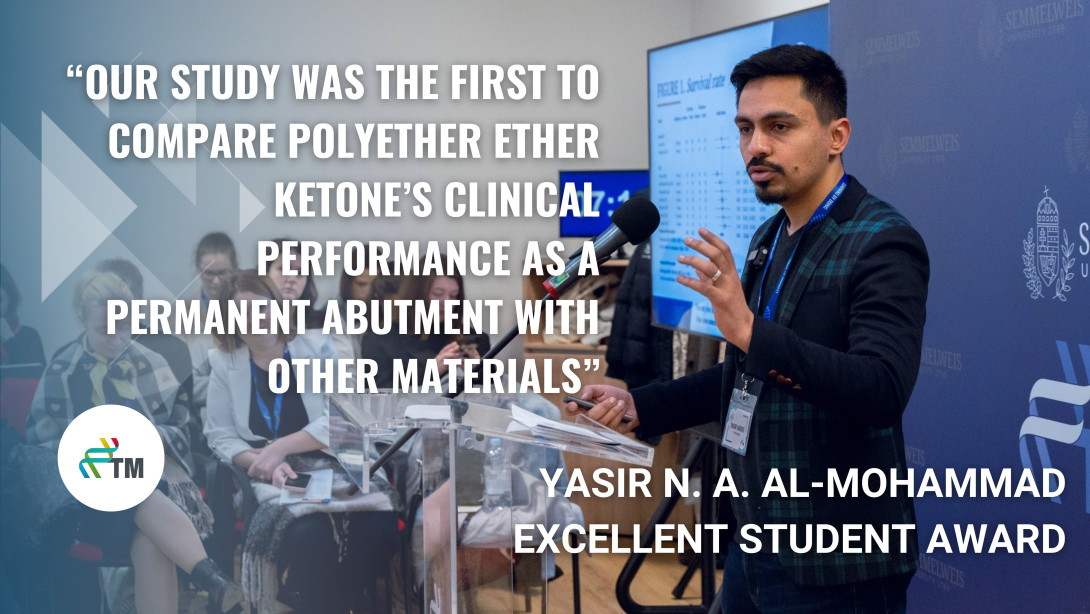
He has investigated the most recent evidence concerning implant abutments in fixed and removable prosthodontics, to provide patients with durable, aesthetically pleasing, and comfortable prostheses. In June this year, he took his Complex Exam, where he reported his excellent results. These are about to be published in the world's most renowned dental journal, Periodontology 2000. Yasir N. A. Al-Mohammad was honored with the Excellent Student Award by the Centre for Translational Medicine.
Dr. Al-Mohammad applied for the Stipendium Hungaricum scholarship in 2023 from the Department of Prosthodontics, University of Basrah. At Semmelweis University, he came into contact with Professor Gábor Varga, who drew his attention to the Centre for Translational Medicine Ph.D. program. “In dentistry, I love all fields of prosthodontics, such as implants, fixed or removable prostheses, and maxillofacial prostheses. I have been involved in three research projects. The first one was related to implant abutments, and its results have already been accepted for publication in Periodontology 2000. In that research, we compared the long-term success of zirconia, polyether ether ketone, and titanium implant abutments. We screened multiple clinical studies to compare the differences in the clinical performance among these materials,” he says.
His most exciting results were related to polyether ether ketone (PEEK). “Our study was the first to compare its clinical performance as a permanent abutment with other materials. PEEK demonstrated good performance over 5 years of follow-up, with respect to survival, technical complications, aesthetics, bone loss, and probing depth, when used as a single crown abutment in anterior and premolar area replacements,” he explains.
The second study of Dr. Al-Mohammad has recently been submitted to Journal of Prosthodontics. In that study, he investigated the efficacy and safety of added soft liners on removable dentures. He concluded that using soft liners in removable dentures improves biting force, mastication, and quality of life and is associated with less pain compared to hard liners. His third project, related to fixed prostheses, is still in progress. In that project, he is comparing the long-term survival and reasons for failure of direct and indirect restorations.
(Szabó Emese)