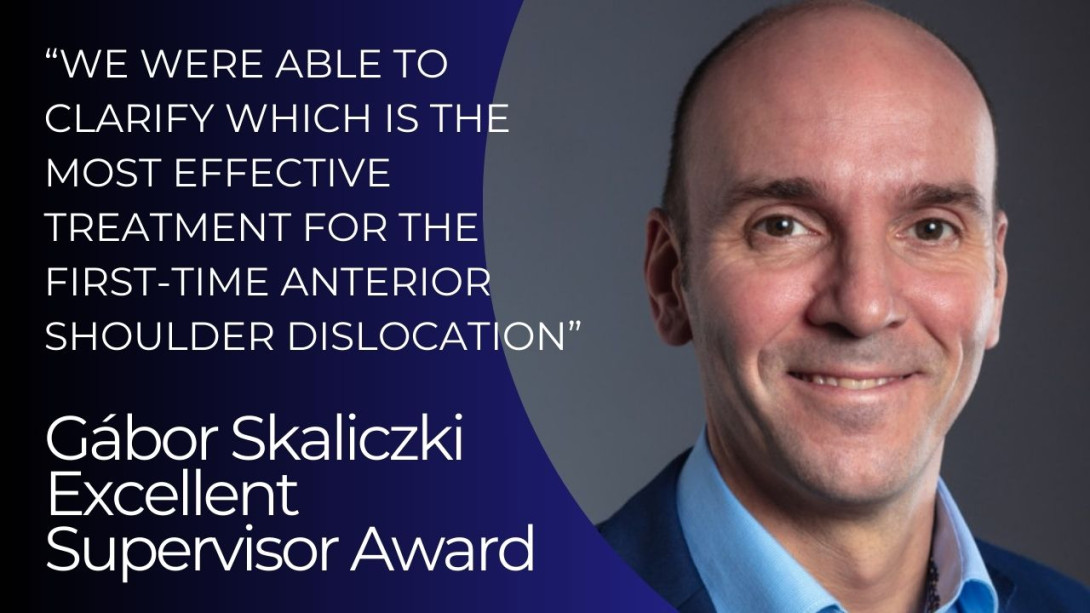
His first Ph.D. student at the CTM training program earned his Ph.D. degree this fall, and his second student has just published a high-impact paper in the Journal of Orthopaedic Translation. In this research, they identified the most effective treatment for first-time anterior shoulder dislocation, helping patients achieve long-term recovery. Gábor Skaliczki was honored with the Excellent Supervisor Award by the Centre for Translational Medicine.
Gábor Skaliczki is the Deputy Director of the Department of Orthopaedics at Semmelweis University, who joined the Centre for Translational Medicine Ph.D. program as a supervisor in 2021. His first Ph.D. student was Viktor Weninger, who published two papers in D1 journals and defended his Ph.D. thesis in October this year. Dr. Eszter Éva Virág-Tulassay began her Ph.D. training in 2023 under the supervision of Dr. Skaliczki, and took her Complex Exam this June. She has recently published a paper in the Journal of Orthopaedic Translation.
“Dr. Virág-Tulassay's achievement is remarkable because this D1 journal is one of the world's most prestigious orthopedic journals. For this reason, this result was a great success for us. In our research, we have explored which is the most appropriate treatment option for anterior shoulder dislocation. Previously, there was no international recommendation on this issue; some doctors believed that conservative therapy might be sufficient, while others were convinced that immediate surgery is necessary. Clarifying this question was important because it is well known that people who suffer anterior shoulder dislocation in their youth are almost certain to experience it again in a few years. Our research has shown that Bankart surgery has the highest efficiency and the lowest rates for complications in acute anterior shoulder dislocation. It has also been found that this type of surgery is the most effective way to reduce the risk of re-injury in two years,” says Dr. Skaliczki.
Currently, Dr. Virág-Tulassay is working on her second project, which also focuses on shoulder stability. She is studying a new type of surgery, dynamic anterior shoulder stabilization (DAS), and evaluating its efficacy. This research is expected to be completed by the end of the following semester. Dr. Skaliczki's third Ph.D. student is Péter Dániel, who began his Ph.D. studies this academic year. He is an MD-Ph.D. student who is comparing the efficacy and safety of hydrodistension with other non-surgical interventions in patients with frozen shoulder in his first project.
(Szabó Emese)