
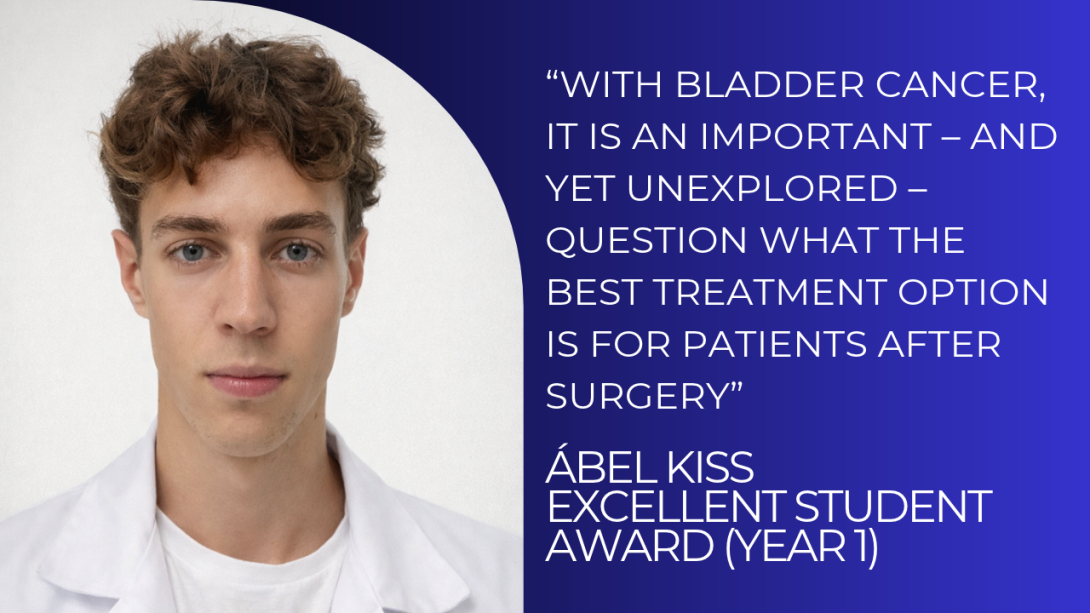
His research topics, related to bladder cancer, are highly relevant and have significant clinical implications. He conducts his research efficiently and precisely, and presents his work and findings flawlessly. Ábel Kiss was honored with the Excellent Student Award by the Centre for Translational Medicine.
Dr. Kiss graduated last year with a degree in pharmacy from the University of Pécs, and as he was primarily interested in clinical pharmacy, he began working as a resident at the university clinic in September. He is employed by the Institute of Clinical Pharmacy, which is a part of the Clinical Center. “I’ve always been interested in research, but I couldn’t see myself doing it full-time. That’s why I was thrilled when I heard about the hybrid program, which would allow me to conduct research alongside my work as a pharmacist. I learned about this opportunity from a lecture by Prof. Peter Hegyi, and I applied right away.”
Since the Institute of Clinical Pharmacy operates on a rotation system, Dr. Kiss has already had the opportunity to spend time in every unit of the clinic and gain insight into how they run. When he visited the Institute of Oncotherapy, he found the work being done there very interesting. This was combined with his long-standing interest in oncology. “When I applied to the Ph.D. program, I already knew that I wanted a research topic related to oncology. To explore potential topics, I consulted my supervisor, Dr. Péter Sarlós, who pointed out that bladder cancer might be a good choice. With this cancer, it is an important – and yet unexplored – question what the best treatment option is for patients after surgery. In our specific study, we compare chemotherapy with immunotherapy in patients with intermediate-risk non-muscle-invasive bladder cancer. In this type of cancer, these treatments are not administered into the patient’s veins but are instead delivered directly into the bladder. As a result, the chemotherapy does not have the same side effects as traditional chemotherapy treatments. When we compare immunotherapy and chemotherapy for this disease, our most important questions are the recurrence rates after each treatment and the long-term survival rates. It’s also important to assess the side effects and determine which treatment is more beneficial from that perspective. Our assumption is that the immunotherapy currently recommended by most protocols has more serious side effects.”
The research Dr. Kiss conducted as an undergraduate was very different from what he does now. That was also related to oncology, but focused on laboratory work. “We researched a chemotherapeutic agent that was a new compound and did not yet have an approved indication for any type of cancer. We were interested in how its structure changes when exposed to radiation.” While that research wasn't directly linked to patient care, their current research is. That has direct benefits in clinical practice, as it may help make the treatment of bladder cancer more effective. They have already assessed the scientific articles published on this topic and determined whether their quality is sufficient to serve as a basis for a meta-analysis. Currently, they are drafting the study protocol, which outlines how they will carry out their project.
(Szabó Emese)