
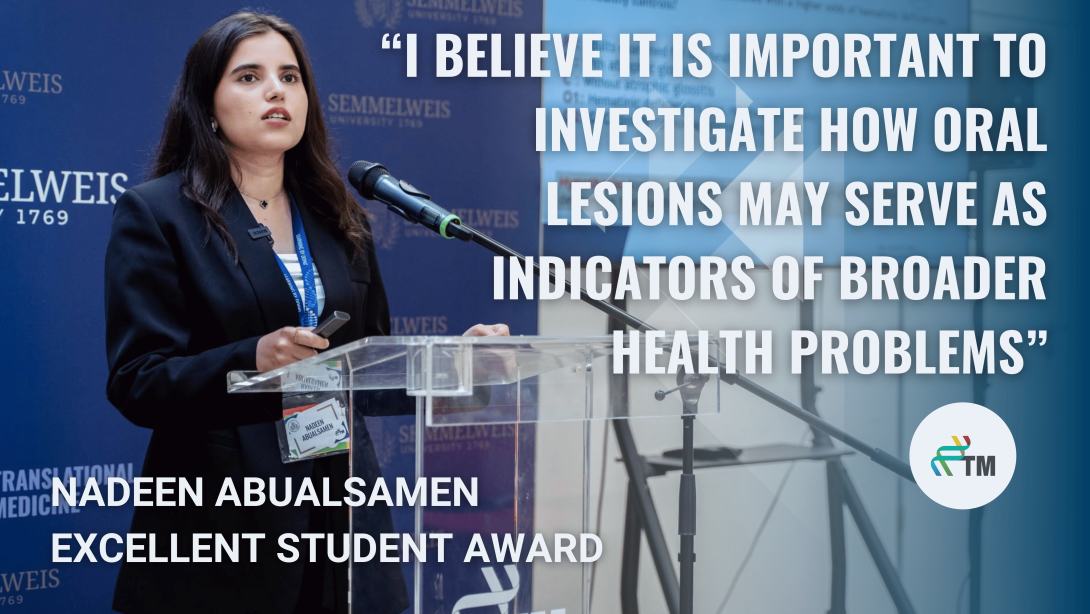
She enrolled in CTM’s MSc program with the goal of identifying systemic and histopathological factors in common oral mucosal conditions. In her first project, she investigated the association between atrophic glossitis and the prevalence of iron deficiency, while in her second project, she is focusing on the diagnostic differences between oral lichen planus and oral lichenoid reaction. Nadeen Abualsamen was honored with the Excellent Student Award by the Centre for Translational Medicine.
She is a dentist, and her interest in translational medicine started when she realized how research can directly improve patient care and clinical decision-making. Dr. Abualsamen believes that research becomes meaningful when it transforms overlooked clinical signs into opportunities for earlier diagnosis and better patient outcomes.
“I became interested in oral mucosal diseases because oral manifestations can reflect underlying systemic conditions. This motivated me to study how oral lesions may serve as indicators of broader health problems. In our first project, we investigated atrophic glossitis. It’s a problem with an unknown cause, and which is usually treated by dentists as a localized issue. Since underlying systemic problems are typically not investigated in this condition, associated problems are also left untreated. For this reason, our meta-analysis was useful, as it showed that patients with this condition have significantly higher rates of iron, vitamin B12, folate, and hemoglobin deficiencies, suggesting that atrophic glossitis may be an important clinical marker of systemic imbalance.”
In her second project, Dr. Abualsamen aims to investigate histopathological differences between oral lichen planus and oral lichenoid reaction to improve diagnostic accuracy. This research is important because distinguishing between these two conditions remains a diagnostic challenge due to overlapping clinical and histopathological features. In this project, the clinical question is whether the number of mast cells, their degranulation, and the thickness of the basement membrane differ between these two conditions. The researchers hypothesize that patients with oral lichen planus show different mast cell activity and altered basement membrane thickness compared to those with oral lichenoid reaction. The related research is still in its early stages but is progressing well.
(Szabó Emese)