
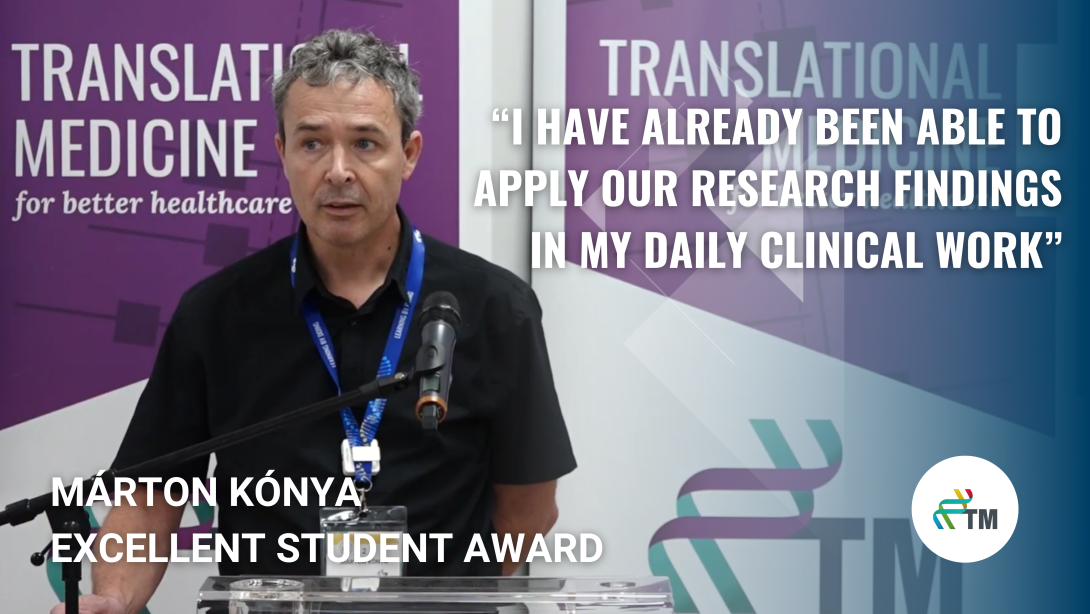
He is conducting research on noninvasive prenatal testing, with a particular focus on how discordant findings may occur during screening for rare chromosomal abnormalities, and how these findings may indicate adverse pregnancy outcomes and maternal malignancies. His research on this topic was published in a D1 journal. Márton Kónya was honored with the Excellent Supervisor Award by the Centre for Translational Medicine.
Márton Kónya has been working as a biologist in private laboratories for more than 25 years, and began specializing in prenatal testing in 2002. He was the first in Hungary to implement combined screening at such a laboratory, and he also played a role in the introduction of Non-Invasive Prenatal Testing (NIPT). Since he did not work in an academic field, he did not have the opportunity to pursue scientific research, but the idea of doing so had always intrigued him. For this reason, he was very pleased to join the CTM training program four years ago. “Anikó Gál drew my attention to this opportunity, and she also became my supervisor at the Centre. I know this is less common, but I think it’s helpful if someone already has professional experience before starting a Ph.D. training program. For me, this was a major advantage, because I already had a lot of knowledge about the field I was beginning to research.”
Márton Kónya had long been bothered by the fact that when a screening test gave a positive result for a rare chromosomal abnormality, he was unable to provide accurate information about the exact genetic risks. “In such cases, we could only make general statements and roughly estimate the risk. That was the reason why my supervisor and I began our research. In our first meta-analysis, we examined the test results of Genome-Wide Non-Invasive Prenatal Testing (GW-NIPT) for individual chromosomes. We found that screening with GW-NIPT can help in the early detection of rare chromosomal abnormalities. It has also been found that GW-NIPT shows a minimal increase in the false positive rate but can detect all chromosomal abnormalities with mutations above the detection limit defined by the manufacturer. Therefore, confirmation of a positive result with an invasive diagnostic test is essential to verify the fetal status.”
The researchers also knew that even if the fetus is not affected by rare chromosomal abnormalities, the risk of placenta-mediated complications can still be high in the case of a false-positive GW-NIPT test result. For example, intrauterine growth restriction and preterm birth may occur. “Although we were aware of this, we were not able to determine the extent of the risks in this context either, so in our second study, we sought to explore how this could be done. No previous studies had specifically addressed this question, so our findings represent a significant breakthrough. Identifying potentially high-risk pregnancies at an early stage is beneficial because it allows serious consequences to be prevented through targeted follow-up.” The researchers’ meta-analysis also revealed that complex, multichromosomal Genome-Wide Non-Invasive Prenatal Testing results are occasionally associated with maternal malignancies. For this reason, a consultation with an oncology-hematology specialist is recommended in such cases to rule out occult maternal malignancy.
Márton Kónya has already been able to apply the research findings in his work, successfully integrating them into his daily clinical practice. On the one hand, this new knowledge helps prevent birth complications; on the other hand, by explaining and interpreting the results, it helps reduce the stress that expectant mothers experience when they receive a positive test result.
(Szabó Emese)