
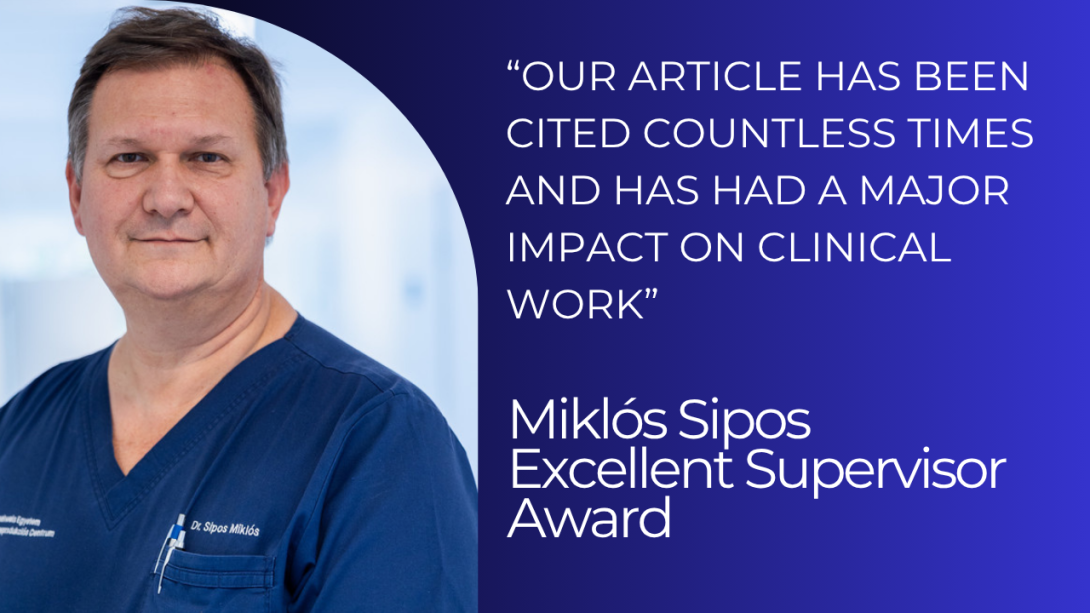
He is the director of Semmelweis University’s Assisted Reproduction Center, and as a supervisor, he was happy to get involved in CTM’s Ph.D. program. Currently, he has three students, one of whom recently published a paper in a highly renowned scientific journal. Miklós Sipos was honored with the Excellent Supervisor Award by the Centre for Translational Medicine.
Dr. Sipos has two second-year Ph.D. students enrolled in CTM's training program – Begüm Kepkep and Máté Botos –, and a third-year student, Máté Éliás. “I’ve been working as a doctor for thirty-five years, and I really like the Centre’s training structure and system. This program attracts the university’s most experienced faculty members and it’s also able to motivate young colleagues interested in scientific work. It is incredibly valuable that in this program, clinicians’ research is supported by statisticians and science methodology supervisors. To illustrate this, I’ll give an example that clearly demonstrates its importance. The background to this story is that writing our first article with Dr. Éliás took a little longer than expected, and as a result, three meta-analyses on the same topic we were working on were completed before ours. These were published, and our article was rejected based on that. At this point, I appealed to the editor-in-chief to review the three previously published papers from a methodological perspective and to compare them with ours. The reviewers recognized that our research was much stronger and stood on much more solid ground than the other meta-analyses. Thus, there was no longer any obstacle in the way of our publication. This article has been cited countless times since then and has had a major impact on clinical work.”
One of Dr. Sipos’s second-year students has also had a paper published. “Dr. Kepkep’s research findings were published in the D1 journal Reproductive Biology and Endocrinology. This study focused on total fertilization failure, which is one of the most frustrating phenomena in assisted reproductive technology. This means that we examine child-planning couples for months and do everything we can to ensure the success of the assisted reproductive procedure, but fertilization does not occur despite the stimulations. We already knew that total fertilization failure can result from both male and female gamete factors, but in some cases, we were unable to identify the underlying cause. For this reason, we sought to determine in our research what other factors might be contributing to this outcome. Our meta-analysis revealed that oocyte gene mutations may play a significant role in this. Since these mutations are very rare, our work was challenging; we had to find and analyze hundreds of studies. Our work was valuable because it highlighted that genetic screening is very important in women with unexplained infertility or repeated failures of assisted reproductive technology. Doing so can prevent unnecessary attempts at conventional assisted reproductive procedures. In such cases, it is better to opt for intracytoplasmic sperm injection, and if that also fails, fertilizing and implanting a donor egg may be a viable option rather than further hormone treatments.”
Dr. Botos is also making good progress with his research. He is conducting research on adenomyosis and is working to identify the most effective assisted reproduction protocol for infertile women with this condition. In his first project, he is investigating the efficacy of GnRH agonist pretreatment in such cases before frozen embryo transfers. A publication on this topic is expected to be published soon. In his second project, he is examining the effectiveness of various noninvasive treatments, such as radiofrequency ablation, as fertility-sparing treatments for women with adenomyosis.
(Szabó Emese)