
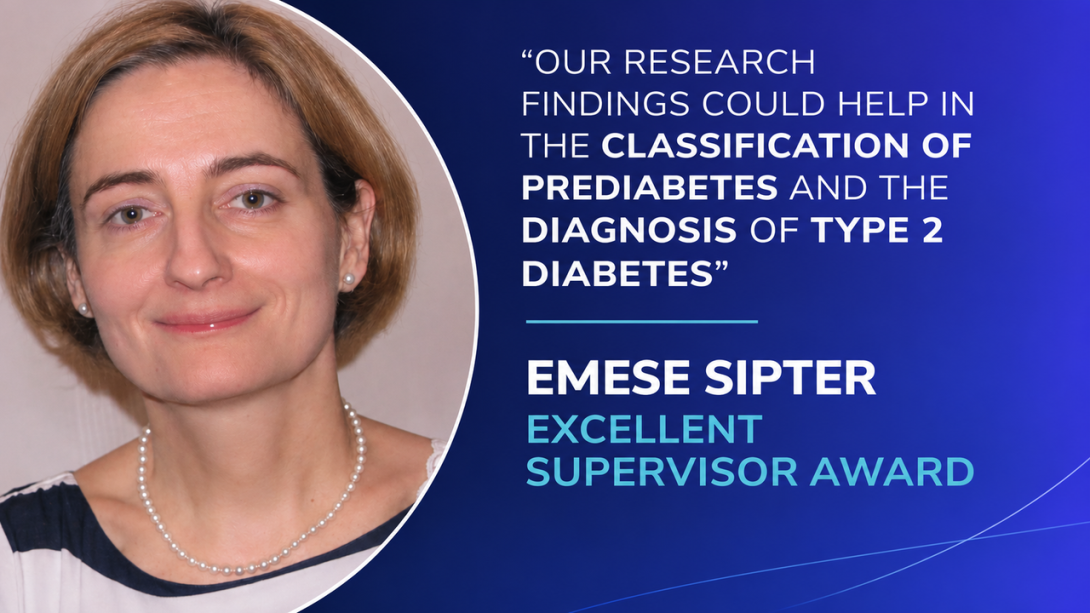
Her Ph.D. students are making excellent progress with their research; one of them has already defended her dissertation and earned her doctoral degree this October. Emese Sipter was honored with the Excellent Supervisor Award by the Centre for Translational Medicine.
Emese Sipter is an assistant professor and diabetologist at the Institute of Pancreatic Diseases, Semmelweis University, joining CTM's training program as a supervisor in 2024. One of her students, Gabriella Rákóczi, successfully defended her doctoral dissertation this past October. In her research, she explored continuous glucose monitoring for the classification of prediabetes, and made excellent progress on this project. Her findings were published in Diabetes Research and Clinical Practice.
“Our findings were significant because they could help in the classification of prediabetes and the diagnosis of type 2 diabetes. Currently, these diagnoses are based on fasting plasma glucose tests, hemoglobin A1c tests, and oral glucose tolerance tests. We compared the performance of these tests with that of a continuous glucose monitor (CGM). A CGM is a wearable device that tracks glucose levels in real time. We evaluated whether continuous glucose monitoring metrics can classify prediabetes with a performance level approaching that of hemoglobin A1c and fasting plasma glucose. Our research showed that, although continuous glucose monitoring is a more expensive test that requires a separate device, its performance is comparable to that of currently used methods. A major advantage of continuous glucose monitoring is that it does not require blood sampling or laboratory support. Continuous glucose monitoring can also help people who are not affected by diabetes track how their blood sugar levels change in response to, for example, certain meals or physical activity. This knowledge can help them make lifestyle changes.”
In addition to her recent graduate, Dr. Sipter has two third-year students in the CTM program. One of them is Anca Cristina Dolhascu, who is currently a pulmonology resident. “She explores the relationship between cystic fibrosis and insulin treatment. In her first meta-analysis, she investigates whether this therapy has a beneficial effect on the quality of life of these patients. My other third-year student is Judit Eleonóra Nagy, who is researching the potential cardiovascular complications of obesity. In her research, she aims to clarify the risk factors for atherosclerosis in obese people.”
Dr. Sipter also has first-year Ph.D. students in the CTM program. One of them is Innocent Yandemye, who works in healthcare management in his home country, Burundi. In his dissertation, he is investigating global differences in glycemic control among adults with type 2 diabetes. The other first-year Ph.D. student, István Csorba, is supervised jointly by Dr. Sipter and Professor Péter Ferdinandy. He is investigating the effects of GLP-1-based therapies on the development of sarcopenia. Since these medications are now widely used worldwide, this is a very important research topic. Dr. Sipter believes that CTM's program is highly motivating not only for students but also for supervisors. It allows them to develop and gain new knowledge continuously. Group meetings are also useful because they foster a sense of community, which makes research work more effective.
(Szabó Emese)