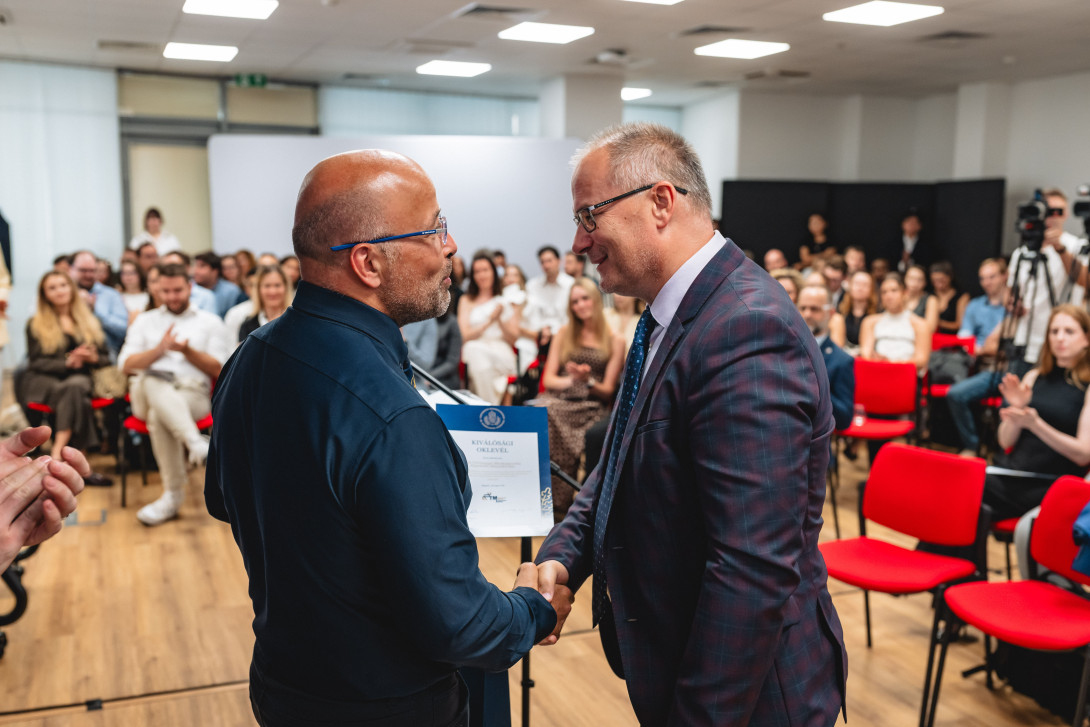
The Markusovszky University Teaching Hospital is the only broad-spectrum hospital in Vas County and one of the decisive healthcare providers in the West Transdanubian region. The institution with modern infrastructure and a strong tradition of teaching, will be the first non-university hospital in Hungary to establish a Translational Medicine Campus. The hospital’s commitment to science-based medicine has been recognized with the Excellence in Modern Patient Care Prize. The award was presented at CTM’s opening ceremony for the 2026–2027 academic year.
The Vas County Markusovszky University Teaching Hospital has a long-standing tradition of training healthcare professionals; it has been serving as a teaching hospital for the University of Pécs since 1967. It offers training programs in medicine, nursing, midwifery, and health sciences, and starting this September, CTM’s Ph.D. program will also be available there. This will be the first non-university hospital in Hungary to establish a Translational Medicine Campus. This presents a unique opportunity for the hospital’s physicians, pharmacists, and other healthcare specialists to engage in scientific work on-site, alongside their clinical duties.
“We are delighted that CTM is offering off-site courses at our hospital, as this makes it easier for our colleagues to participate in the program. Since we believe scientific approach is very important, we recently established a Scientific Directorate at our institution as well. We would also like to involve international professors in the research being conducted here. The Translational Medicine Campus could be established at our institution because this academic year, 15 healthcare professionals have enrolled in CTM’s Ph.D. program – a number large enough to bring the lecturers to us rather than requiring our colleagues to travel. This is a huge advantage for the hospital, as it makes it easy to balance research with clinical work. We are particularly pleased that the opportunity to engage in research helps us retain our employees and even attract new professionals. I believe that strengthening our research efforts has a positive impact on patient care as a whole,” says Norbert Lippai, Director General.
Although the Translational Medicine Campus has just been established at Markusovszky Hospital, two of its physicians had already enrolled in the Centre's training program individually. One of them is Melinda Piri, who is a clinical oncology resident at the hospital and a third-year Ph.D. student at CTM. She is researching novel approaches in treating pancreatic ductal adenocarcinoma. Tamás Óvári is also a third-year Ph.D. student at CTM, and he works as a senior resident in the hospital’s psychiatric ward. As a Ph.D. student, he is researching the correlation between heart rate variability and anxiety severity, and comparing different therapeutic approaches in patients with anxiety disorders. Dr. Óvári and Dr. Piri had to travel to Budapest regularly for their training, but thanks to the opening of the new campus, Ph.D. students just starting their studies no longer need to do so.
Healthcare professionals joining CTM’s program this September have not yet settled on a research topic – they will choose one during their first year, in parallel with their training. But there are exceptions, of course. “There are some who already know what they’re going to research and have already found a supervisor. Others will look for a mentor based on their topic, hopefully within our hospital. We encourage our senior colleagues to take on this role and support the students’ research,” says the director. Healthcare professionals who have just begun their Ph.D. programs come from a variety of fields: among them there are residents and specialists in areas such as gynecology, dermatology, otolaryngology, traumatology, surgery, and pharmacy. Since this is the essence of translational medicine, they all intend to choose a research topic that stems from daily practice and helps improve patient care.
(Szabó Emese)