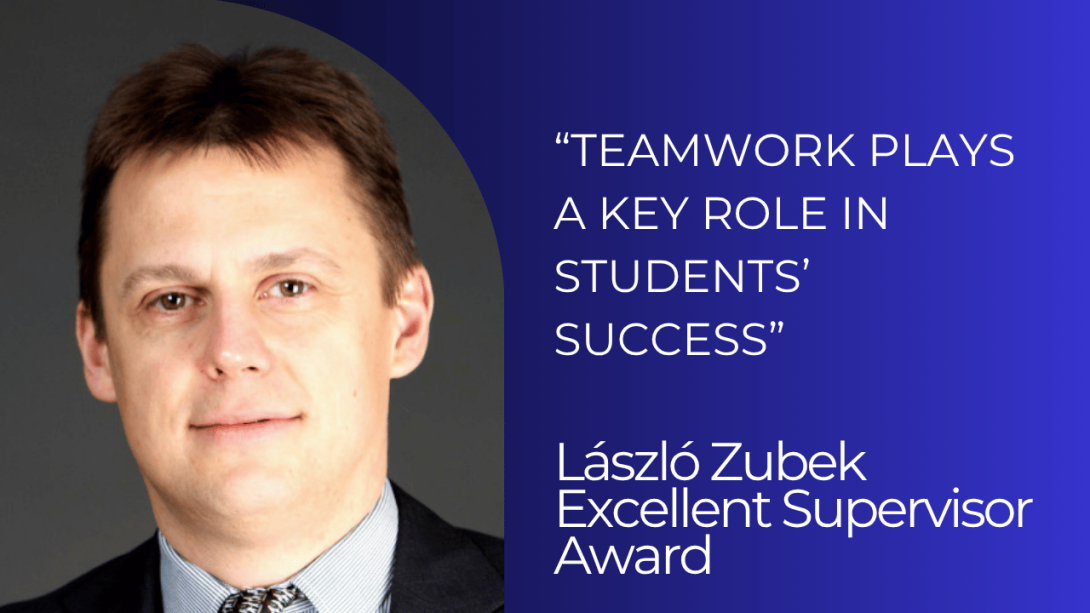
He is not only a leader at the Critical Care Group, but also one of its most active supervisors. During the recent academic year, he assisted two first-year, five second-year, one third-year, and one fourth-year student with their research, and one of them has recently published her research findings in a D1 journal. László Zubek was honored with the Excellent Supervisor Award by the Centre for Translational Medicine.
Dr. Zubek has long been involved in CTM’s Ph.D. training program as a supervisor, and he typically guides his students through the world of science together with Prof. Dr. Zsolt Molnár. Many of their students have achieved outstanding results in their research. Most recently, Liliána Nagy published her research findings in a D1-level journal. Dr. Zubek emphasizes that teamwork plays a key role in their students’ success, and that the support students and supervisors receive from CTM’s experts is extremely helpful.
“In her first project, Dr. Nagy investigated the efficacy and safety of advanced versus conventional hemodynamic monitoring in patients with shock. She was one of our first MD-Ph.D. students, and currently, she is a resident at our Department of Anesthesiology and Intensive Therapy. I always draw students’ attention to the MD-Ph.D. program because it not only offers research opportunities but also gives young professionals the chance to join a top-tier clinical department right after graduation. Since medical students have very little clinical experience in the first year of the MD-Ph.D. program, supervisors' work can be challenging during this period. But later on, MD-Ph.D. students can work independently as Ph.D. students.”
Dr. Nagy’s study was particularly important because mortality in shock can reach 60%, but immediate, adequate resuscitation can reduce this rate. Detailed hemodynamic monitoring supports decision-making regarding this intervention, but there was no accurate information on exactly how it benefits patient outcomes. Therefore, Dr. Nagy aimed to compare advanced hemodynamic monitoring guided clinical decision-making and treatment with conventional ones in terms of outcomes in shock. “In intensive care, we have a wide range of tools that can help us treat patients in shock. To use these tools as efficiently as possible, we need to assess patients' conditions as accurately as possible. Hemodynamic monitoring can be performed non-invasively using ultrasound devices, and it can also be done using catheters inserted into blood vessels. This provides continuous monitoring, which, in some cases, can be even more helpful to the physician. Our research revealed that advanced hemodynamic monitoring is associated with a significant reduction in mortality among patients with shock, with the greatest benefit observed in cardiogenic shock.”
Other students of Dr. Zubek are also making good progress in their research. “Gábor Nagy’s first paper is currently under review by a scientific journal. He was comparing the safety and effectiveness of personalized versus fixed-volume resuscitation in septic patients. The idea for this topic was inspired by the fact that personalized therapy has long been associated with better outcomes compared to the guideline-recommended fixed-volume strategy, but the evidence on its efficacy and safety was limited. For this reason, we examined this issue from a scientific perspective.” Júlia Hollósi investigated the safety and effectiveness of intravenous immunoglobulin treatment versus blood purification in septic patients in her first project, and her manuscript is also expected to be published soon. Zsuzsanna Weber conducted a meta-analysis on an anesthesiology topic, which is also awaiting publication. She investigated the safety of continuing renin-angiotensin-aldosterone inhibitors for non-cardiac surgery. It was important to clarify this issue because it was unclear whether these medications should be discontinued before surgery.
Krisztina Csőke-Kabai investigated the efficacy and safety of prehospital targeted temperature management on neurological outcomes in out-of-hospital cardiac arrest patients in her first project. Since Dr. Csőke-Kabai is a senior resident at the University of Szeged, Department of Emergency Medicine, answering this question could also be very helpful in decision-making in her day-to-day work. In her second project, she is investigating the efficacy and safety of seizure prevention on neurological outcomes in cardiac arrest patients. Levente Prácser has also chosen an important research topic. He has been investigating the effects of inappropriate antibiotic use on the complication rate in the intensive care unit. Through this research, he draws attention to the importance of well-considered, personalized antibiotic treatment. His manuscript is now complete and expected to be published.
Dr. Zubek’s fourth-year student, Nikolett Kiss, will soon complete her Ph.D. training and defend her thesis. Her first research, which investigated the predictive value of urinary biomarkers in acute kidney injury related to cardiac surgery, has already been published in a D1 journal. In her second project, she developed a protocol for a randomized clinical trial conducted at the Department of Anesthesiology and Intensive Therapy, Semmelweis University, and at other clinics. The goal of this clinical trial is to determine in which cases blood transfusions should be administered to patients in the intensive care units.
(Szabó Emese)