
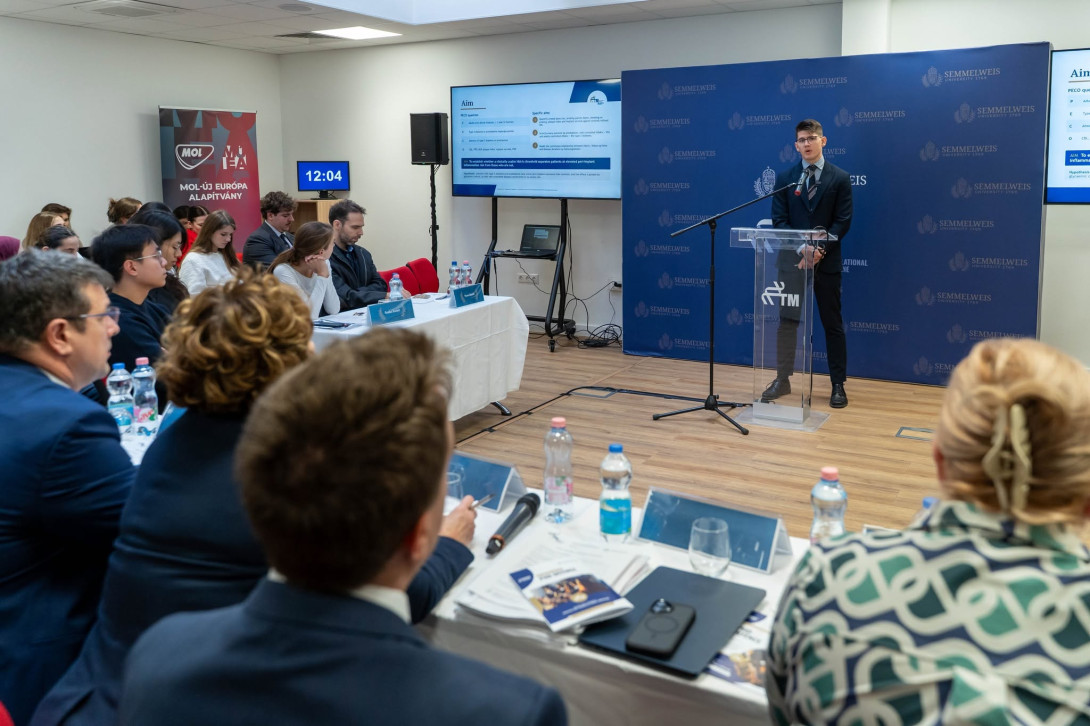
In October 2026, twenty-five candidates presented their Ph.D. theses at a four-day event organized by the Centre for Translational Medicine. As it is usual at CTM, doctoral defenses were evaluated by committees whose members included professors from Hungarian and international universities. The scientific results presented at the defenses had already been published in top-tier Q1 and D1 journals. Four candidates even had authored two D1 publications each, and one of them was able to publish three of her research findings in D1 journals.
The candidates who defended their Ph.D. theses at CTM's event in October came from a wide range of medical fields: eight from gastroenterology, four from dentistry, and three from gynecology. In addition, there were candidates from pediatrics, dermatology, critical care, orthopedics, cardiology, otolaryngology, and psychiatry. Each day of the event started with opening remarks delivered by Professor Gábor Varga, General Vice Director, or Professor Péter Hegyi, Director of the Centre for Translational Medicine. Their speeches were followed by presentations given by the candidates: on the first day, seven of them delivered their talks; on the second day, six; on the third day, eight; and on the fourth day, four.
The research findings they presented had already been published in renowned journals in previous years or months: fifteen had at least one D1 paper, and four had both of their papers published in D1 journals. There was also a candidate who was able to publish three of her research results in D1 journals. After delivering their presentations, the candidates answered the committee’s questions. Its members included professors from universities in Hungary, as well as from Slovenia, Romania, the United Kingdom, Germany, and Lithuania. As they were satisfied with the candidates’ overall performance, their presentations, and their answers to the questions, they congratulated them at the end of the thesis defense.
On the days of the Ph.D. defenses, renowned professors also gave lectures. The first was delivered by Professor Tamás Szili-Török, Director of the Cardiology Center at the University of Szeged, titled “Robotics at the frontier of science: from innovation to clinical impact”. Professor Szili-Török is an internationally recognized cardiologist and electrophysiologist who brings world-class expertise to the University of Szeged. As a specialist in the diagnosis and advanced treatment of complex cardiac arrhythmias, he leverages cutting-edge catheter ablation techniques and innovative mapping technologies to restore healthy heart rhythms. Having previously built an exceptional clinical and research career at leading European institutions, Dr. Szili-Török combines high-impact scientific research, clinical leadership, and student mentoring with a deeply patient-centered approach to significantly improve cardiac care and save lives every day.
The second presentation was given by Robert Sutton, Professor of Surgery at the University of Liverpool, and was titled “Developing a drug for acute pancreatitis.” Prof. Robert Sutton is an academic pancreatic surgeon specializing in exocrine pancreatic diseases. His work bridges laboratory research and clinical medicine to advance the understanding and treatment of acute pancreatitis.
His research primarily investigates the cellular mechanisms driving organ injury, including cytosolic and mitochondrial calcium overload, oxidative stress, and cytokine cascades that lead to severe systemic dysfunction. To translate these insights into patient care, he focuses on drug discovery, multi-omics analyses, and the identification of novel biomarkers to predict disease severity and progression. Additionally, he leads clinical trials evaluating targeted therapies and novel small-molecule inhibitors aimed at reducing systemic complications, preventing respiratory failure, and improving clinical outcomes for patients with severe pancreatic conditions.
(Szabó Emese)