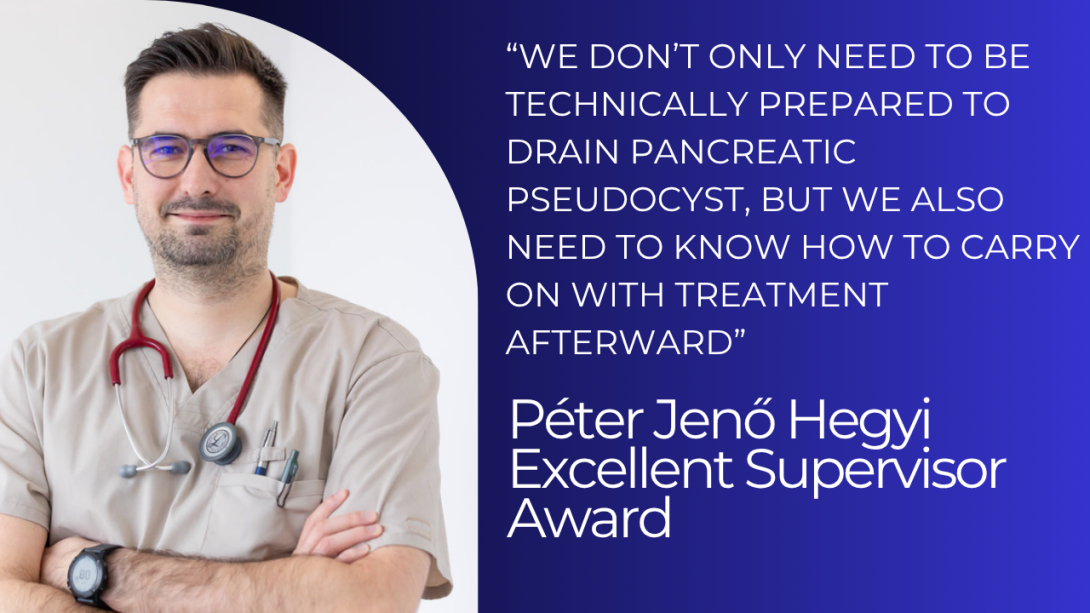
He joined CTM's program nine years ago and has remained committed ever since to the idea that healthcare professionals should engage in research alongside their clinical work. As a supervisor, he is very active and supports his students with great dedication. Jenő Peter Hegyi was honored with the Excellent Supervisor Award by the Centre for Translational Medicine.
Dr. Péter Jenő Hegyi is delighted to help not only Ph.D. students with their research, but also medical and TDK students. This is how his collaboration with his current first-year student, Tom Brand, began. “He attended a lecture I gave on translational medicine to medical students, and my presentation piqued his interest. He approached me after my presentation, and our collaboration began immediately; as a result, we have been working together for two years now. We have been investigating the microbiological profile of infected walled-off pancreatic necrosis and pseudocysts. First, we reviewed the data from our institute retrospectively, trying to determine which pathogens cause infections in these cysts. We considered this an important question because cyst infection is one of the most serious complications of severe pancreatitis. We had a large amount of data available for the retrospective study, as we treat the most patients with this condition in Eastern Europe. The procedure itself is performed by endoscopically inserting a stent into the cyst through the stomach, which allows us to open it up. Then we can drain the fluid from it and scrape out the necrotic tissue. Our research was groundbreaking, because, until now, there had been very little information worldwide about the pathogens found in such cysts. Our research revealed that in a significant number of cases the infection is caused not only by bacteria but also by fungi, primarily Candida. For this reason, patients in such cases should be treated not only with antibiotics but also with antifungal medication.”
The retrospective study was followed by a meta-analysis that reviewed more than 30 scientific publications. “We analyzed data from more than 1,800 patients, which confirmed that Candida is a common pathogen in infected walled-off pancreatic necrosis. Our meta-analysis also revealed that the predominant bacteria in infected cysts vary by continent. This means that these infections must be treated differently in different countries. Tom has presented these findings at several international conferences, and we look forward to publish an article on these in a D1 journal soon. Encouraged by the successes, we launched a national registry on walled-off pancreatic necrosis, which allows us to analyze the data prospectively. This helps us not only be technically prepared to drain pseudocysts, but also to treat patients with the appropriate antibiotics and antifungal medications after identifying their pathogens. This is how treatment can be really personalized and effective.”
Zoltán Bánfalvi, a second-year Ph.D. student of Dr. Hegyi, began his Ph.D. training alongside his clinical work. “He works as a resident at our institute and is researching diagnostic options for pancreatic tumors. It’s important to note that we always take a sample from a pancreatic tumor during an endoscopic ultrasound, and a pathologist instantly performs a rapid on-site examination to determine whether the sample is evaluable. This way, we don't have to wait two weeks for the pathology results to come back to find out whether the collected sample contained evaluable cells, and if it doesn't, we don't have to schedule another appointment for the patient. Doing so would result in a one-and-a-half-month delay in diagnosis, which could make the pancreatic cancer inoperable. In Zoli's project, we investigated whether an endoscopist can determine the evaluability of a collected sample without the assistance of a pathologist or without a microscopic examination. Our results showed that if clinicians pay attention to certain signs, they can determine macroscopically whether a sample is suitable for histological examination. A paper on this research is expected to be published soon.”
Dr. Hegyi's third student is Jakub Hoferica, who completed his fourth year this academic year and will soon defend his Ph.D. dissertation. “Jakub has already returned to Slovakia and has begun clinical work at the Jessenius Faculty of Medicine at Comenius University in Martin. His goal is to share his knowledge with his colleagues there and to implement the translational medicine approach at his institution. We look forward to continuing our collaboration with him in the future and would be happy to welcome Ph.D. students from his institute.”
(Szabó Emese)