
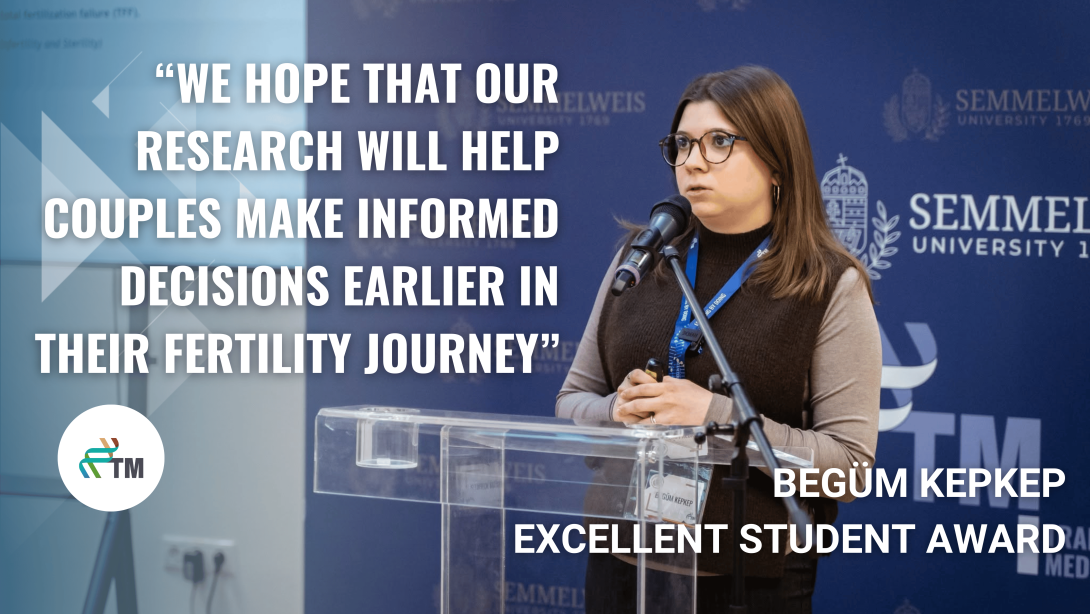
She became involved in scientific work as a TDK student, and after realizing how important research is for improving patient care, she decided to continue it even after earning her medical degree. Currently, she is working as a clinical doctor, and she is pursuing her Ph.D. training alongside her work. She has recently published the results of her research in a D1 journal. Begüm Kepkep was honored with the Excellent Student Award by the Centre for Translational Medicine.
As a TDK student, Dr. Kepkep really enjoyed the scientific side of medicine, so there was no doubt in her mind that she should continue her research as a medical doctor. She believes that being a good clinician also means staying up to date with the latest scientific evidence. Translational medicine was especially appealing to her because it bridges the gap between research and clinical practice, allowing discoveries to have a direct impact on patients’ lives. Her interest was sparked primarily by assisted reproductive technology. “A close family friend is an obstetrician-gynecologist, and during medical school, I had the opportunity to observe her clinical practice. Many of her patients were undergoing assisted reproductive treatments, and seeing both the medical complexity and the emotional challenges these couples faced made a lasting impression on me. It inspired me to learn more about reproductive medicine and ultimately led me to pursue research in this field.”
In her first project, Dr. Kepkep investigated the genetic causes of total fertilization failure (TFF), one of the most challenging complications of assisted reproductive treatment. Her research findings were published in the D1 journal Reproductive Biology and Endocrinology.“We found that mutations in several oocyte-related genes are associated with a significantly increased risk of TFF. Our findings suggest that genetic testing could be beneficial for patients with unexplained infertility who experience unsuccessful treatment cycles. If pathogenic variants are identified, patients can be counseled about their individual risk of TFF and informed about alternative family-building options, such as oocyte donation or adoption. We hope this approach will contribute to more personalized patient counseling and help couples make informed decisions earlier in their fertility journey.”
Dr. Kepkep’s second project has a similar objective but focuses on the male side of fertilization. “While our first study investigated the role of oocyte gene mutations, this project examines sperm-related genetic mutations and their association with fertilization outcomes. I think the two projects complement each other well because successful fertilization depends on both the oocyte and the sperm. We are currently in data extraction phase and are hoping to complete the analysis and submit the manuscript during the fall.” Dr. Kepkep is looking forward to beginning her residency in the Department of Obstetrics and Gynecology at Semmelweis University. She would like to continue combining clinical practice with research, particularly in the field of reproductive medicine, as she believes the two areas complement each other very well.
(Szabó Emese)