
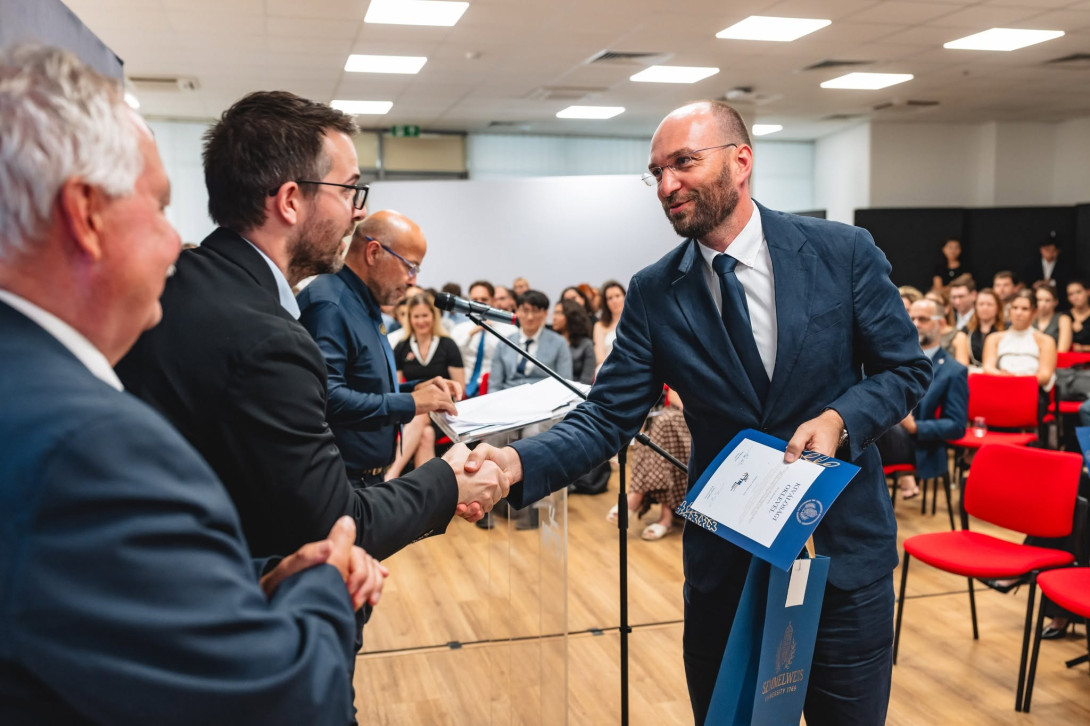
Bethesda Children’s Hospital is one of the leading children’s hospitals in Hungary, with several units and programs unique to the country. The institution’s commitment to science-based medical practice is also outstanding, and it was honored with the Excellence in Modern Patient Care Prize. The award was handed over at CTM’s opening ceremony for the 2026–2027 academic year.
Bethesda Children’s Hospital has a history spanning back 160 years. In 1866, when it was founded, it was the second healthcare institution in Budapest to be established as a public hospital. The institution has operated as a children’s hospital since 1992, and has broadened its spectrum of healthcare services ever since. They run Hungary’s national center for children with severe burn injuries and place great emphasis on the social reintegration of those affected by such injuries. In addition to children with burn injuries, the institution places emphasis on the care of children who are in a coma, unconscious, or on long-term mechanical ventilation. Their department of pediatric surgery provides comprehensive medical services in general pediatric surgery and traumatology, complemented by pediatric urology and orthopedic surgery. They also have a well-equipped pediatric intensive care unit. An important unit of the hospital is pediatric neurology, which specializes in the complex treatment of children with epilepsy. The hospital’s chronic pain clinic is also unique. Another specialty is that the institution has an early childhood intervention unit and several units focused on children with special needs.
Although Bethesda Children’s Hospital is not a university teaching hospital, it has always placed a strong emphasis on the training of healthcare professionals. The Bethesda Academy provides outstanding professional and community education, and cooperates with Károli Gáspár University of the Reformed Church in Hungary to participate in nursing education. The hospital maintains close ties with medical schools and the ELTE Bárczi Gusztáv Faculty of Special Needs Education to support the training of medical students, physical therapists, psychologists, and other healthcare professionals. Several of the institution’s physicians have become involved in CTM’s program as well.
“Currently, six of our colleagues – four residents and two specialists – are participating in CTM’s training as Ph.D. students, and one has already earned his degree. He is Márk Hernádfői, who joined the program right after it was launched in Budapest, and now assists other students as a Scientific Methodology Supervisor. At our hospital, we generally place great importance on scientific thinking, and strive to ensure that our daily practice is based on scientific evidence. We would also like to use this approach to answer questions that arise in patient care. Another important consideration is that residents applying to our hospital have a need to delve deeper into scientific work. This training offers them an excellent opportunity to fulfill that desire,” says György János Velkey, Director General. In addition to the Ph.D. students, there are senior colleagues at the hospital who have gladly joined the program as supervisors. One of them is János Major, Medical Director, and the other is András Fogarasi, Deputy Chief Medical Officer and Director of Research and Education. Dr. Fogarasi not only participates in the program as a supervisor but also serves as a leader of the Pediatrics Group.
The hospital’s physicians address important questions in their Ph.D. research, and their results are outstanding. In his first study, Dr. Hernádfői explored the burden of childhood cancer. In this study, published in JAMA Pediatrics, he examined the social and economic challenges faced by adults affected by such diseases in childhood. His second study focused on the treatment of high-risk neuroblastoma. The research work of current Ph.D. students is also progressing well. Lőrinc Frivaldszky, who is currently in his fourth year, has already had two publications, and he has also joined the CTM program as a Scientific Methodology Supervisor. Although he is a pediatric resident, his research topics are related to gynecology. In his first study, he investigated how to reduce the risk of postpartum depression in women undergoing cesarean sections. In his second study, he compared the effectiveness of pharmacological and non-pharmacological interventions for nausea and vomiting during pregnancy. Tímea Lőrincz-Molnár, who has also just begun her fourth year as a Ph.D. student, has already published a paper. Her research focuses on epilepsy, with a particular emphasis on identifying the key features that might help differentiate epileptic from non-epileptic events during clinical assessment of pediatric patients. This research is also closely tied to everyday clinical practice and helps improve it.
(Szabó Emese)