
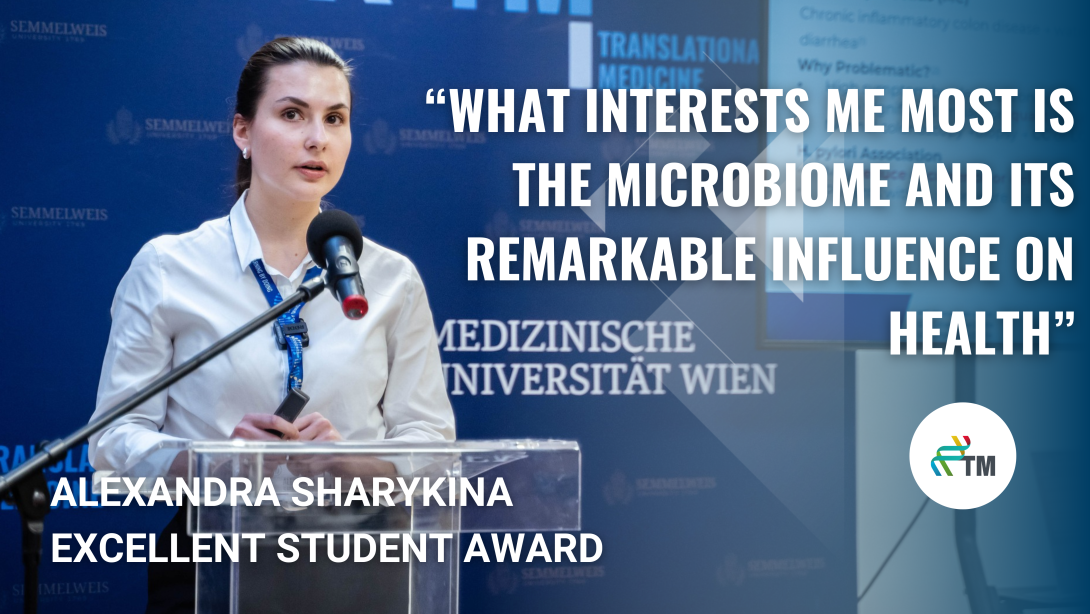
Alexandra Sharykina is highly active and dedicated, and she is making great progress on her projects. She has investigated the prevalence of Helicobacter pylori in patients with microscopic colitis and she has already completed the draft of her manuscript. She was honored with the Excellent Student Award by the Centre for Translational Medicine.
Dr. Sharykina graduated from Semmelweis University last year, and her supervisor, Dr. Emese Mihály, brought the CTM program to her attention. “I had previously worked with her as a medical student at the university. She is a leading expert in inflammatory bowel diseases and microscopic colitis, and I am very grateful to her. She introduced me to this topic and sparked my interest in the field. She had prior experience with CTM and spoke very highly of it, which encouraged me to begin my Ph.D. program here. As for the progress we made, it was entirely thanks to the incredible team around me. I feel deeply grateful for their dedication, hard work, and support. Everyone gave their absolute best and made this project a priority, which is what allowed us to move forward so quickly and achieve so much together.”
Dr. Sharykina has just completed her first manuscript, and her findings support the hypothesis that patients with microscopic colitis have a lower prevalence of Helicobacter pylori. It was important to confirm this because identifying a negative correlation with microscopic colitis may reveal new immunomodulatory pathways and therapeutic targets. “In our meta-analysis, we found a 40% lower prevalence of Helicobacter pylori in microscopic colitis and a 43% lower prevalence specifically in lymphocytic colitis. At the moment, the clinical significance of this association is still unclear, and any interpretation remains largely speculative. However, our team strongly believes that this research provides an important foundation for future basic science studies and deeper investigation into this relationship.”
Dr. Sharykina is most interested in gastroenterology, but she hasn’t yet committed to it. She feels that gastroenterology is such a broad field, with strong connections to many other areas of medicine. That is why clinicians can begin their work by focusing on one topic, and later find themselves working in a completely different system. What fascinates Dr. Sharykina the most right now is the microbiome and its remarkable influence on health and a vast number of diseases.
(Szabó Emese)