
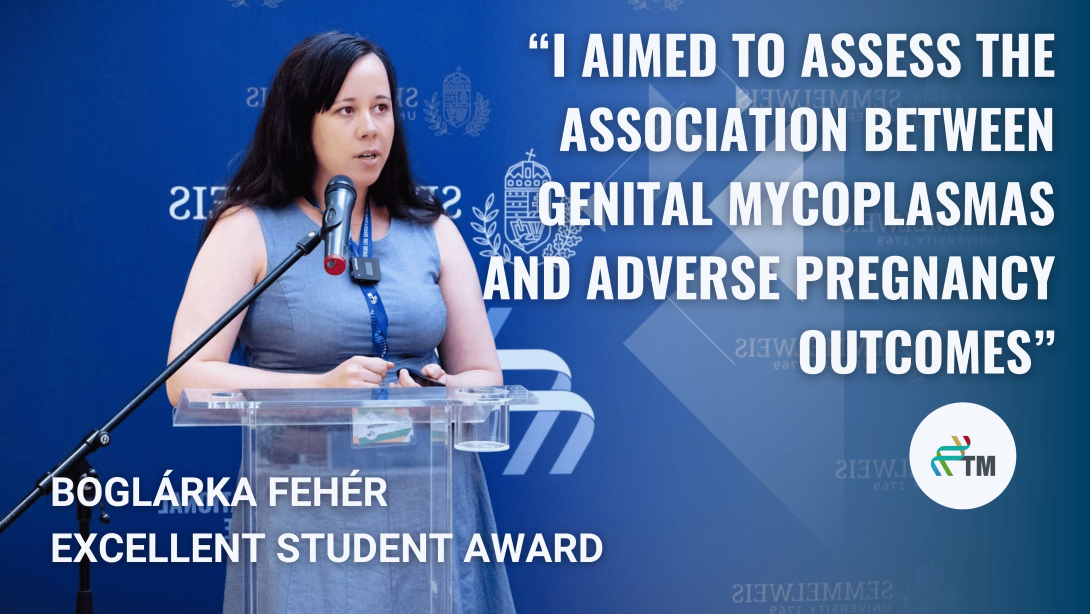
She works as a specialist in the Department of Obstetrics and Gynecology at Semmelweis University, and began her Ph.D. research during her residency. With her research, she has drawn attention to the fact that cervicovaginal detection of genital mycoplasmas should be interpreted within the broader context of the vaginal microbial environment, and it should be acknowledged as a potential risk factor of adverse pregnancy outcomes. Boglárka Fehér was honored with the Excellent Student Award by the Center for Translational Medicine.
Dr. Fehér joined CTM's training program three years ago as a resident, and drew inspiration for her research topic from her clinical work. “I knew that genital mycoplasmas are highly prevalent in women of reproductive age, but I saw that their potential impact on pregnancy is a matter of debate. According to the scientific literature, the relevance of cervicovaginal detection of these pathogens during pregnancy is also controversial. Therefore, in my study, I aimed to assess the association between genital mycoplasmas and adverse pregnancy outcomes, such as preterm birth and low birth weight. This topic was particularly close to my heart because I’ve been interested in infectology ever since I began my residency and started treating pregnant women.”
Dr. Fehér recently published her findings in the D1 journal American Journal of Obstetrics and Gynecology, and her results are already being applied in clinical practice. “Until now, when STI screenings revealed positive results for certain Mycoplasma and Ureaplasma species, we generally did not pay much attention to them because we knew these infections were very common and assumed they did not cause any problems. However, our meta-analysis has shown that the presence of such pathogens may affect pregnancy outcomes. For this reason, their presence should not be automatically ignored; rather, we should take into account that they may increase the risk of preterm birth, spontaneous abortion, premature rupture of the membranes, and low birth weight.
Dr. Fehér focuses on a similar topic in her second project, where she is specifically researching high-risk pregnancies – for example, when premature rupture of membranes has already occurred, or there is a threat of preterm birth. The question in these cases is what to expect in terms of pregnancy outcome if specific Mycoplasma and Ureaplasma species are present in the amniotic fluid or in the vagina. This knowledge can help ensuring that affected pregnant women receive targeted treatment. In practice, this could mean, for example, targeted antibiotic therapy. It could also be important for pregnant women to pay closer attention to maintaining a healthy vaginal flora before and during pregnancy.
(Emese Szabó)