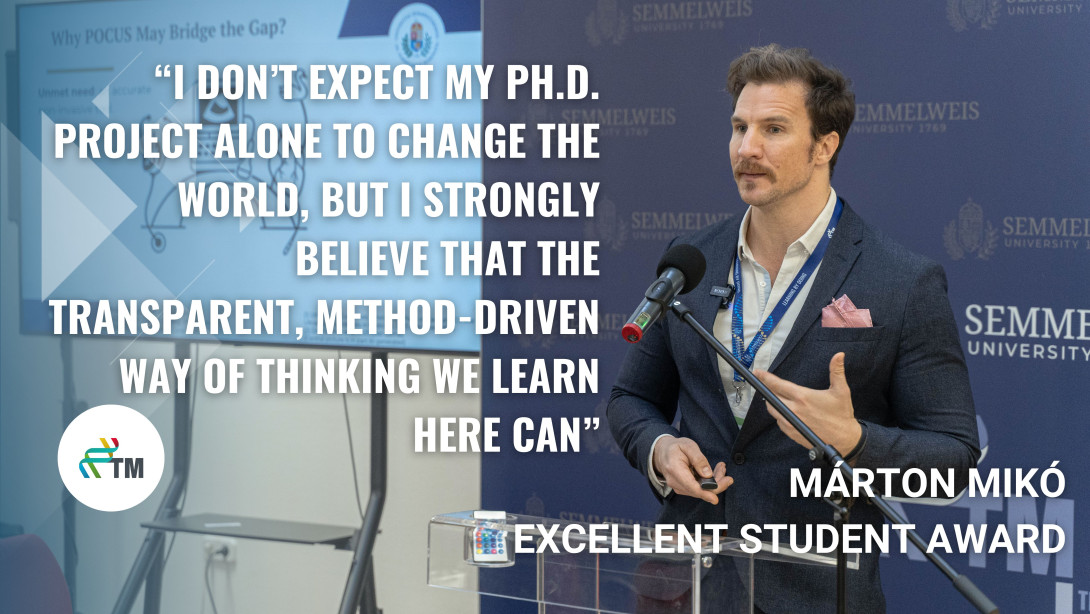
He is an internist who became interested in research alongside his clinical work. He has demonstrated exceptional commitment, research productivity, and professionalism, and has set a positive example for all students with his cooperative spirit. Márton Mikó was honored with the Excellent Student Award by the Centre for Translational Medicine.
After graduating from university, Márton obtained his specialist qualification and began working as a family doctor. A few years later, he decided to return to hospital-based internal medicine, which he considers one of the best decisions of his life. He currently works as an internist at the Center for Geriatric Care and Nursing Science at Semmelweis University, and in addition to his duties there, he has enrolled in the Ph.D. program at the Centre for Translational Medicine. “I don’t expect my Ph.D. project alone to change the world, but I strongly believe that the transparent, method-driven way of thinking we learn here can,” he says. His main goal is to apply the knowledge and mindset he has acquired in the program to his clinical practice.
„As an internist, patient care is what matters the most to me, and I would never give up working at the bedside. I place great importance on differential diagnosis, and I also believe it is essential to always improve my professional skills. This motivated me to buy a handheld ultrasound device, which I always carry with me. I started using it about two years ago, but soon I began to question whether I was using it correctly and for the right clinical indications. I realized that, although relevant literature exists, the data are often conflicting, and current guidelines are relatively weak. Internet-based educational materials, such as videos and podcasts, are helpful, but they lack the level of evidence I was looking for, so I felt it was necessary to assess the potential of this device more systematically. My goal was to find out in which cases bedside ultrasound examinations are truly beneficial to patients,” he says.
In his first research project, Márton investigates the diagnostic accuracy of bedside ultrasound for hypovolemia in adults. Clarifying this issue is important because fluid therapy is one of the most common hospital interventions, but in many cases, doctors make subjective decisions about its application. “This may be problematic in certain cases, where injudicious fluid replacement can cause harm to vulnerable patients. The situation is further complicated by the fact that sometimes differential diagnosis is only possible with invasive procedures, which are not applicable in most cases. For this reason, it would be extremely helpful if we could pinpoint and shortlist those ultrasound indices that could be used as the most reliable methods for determining patients’ fluid status,” he says.
Beyond his current project, Márton emphasizes the importance of the CTM community and its transparent, debate-driven culture, which he compares to a modern, Stoic workshop focused on truth-seeking rather than hierarchy. He hopes that, by combining this methodology with his passion for bedside ultrasound, he can contribute to integrating point-of-care ultrasound as a routine ‘fifth pillar’ of physical examination in internal medicine and in resident education.
(Emese Szabó)