
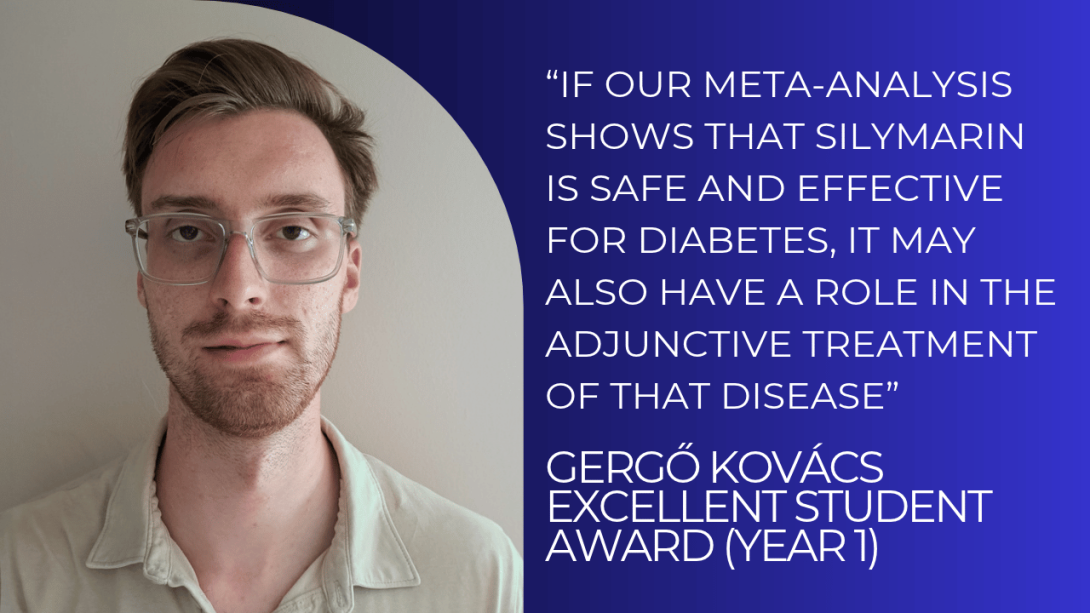
He is researching new insights into therapeutic approaches for diabetes mellitus, which is a highly important and clinically relevant topic. He works quickly and thoroughly, and gives excellent presentations. Gergő Kovács was honored with the Excellent Student Award by the Centre for Translational Medicine.
Dr. Kovács graduated with a degree in pharmacy from the University of Szeged in June this year and began his Ph.D. program at CTM's campus in September. He had already conducted research as a student researcher when he was an undergraduate. “I conducted research at the Institute of Pharmaceutical Chemistry for three years, but aside from writing my thesis based on my findings there, I didn’t find much personal motivation in that type of research. I realized I wasn’t particularly interested in chemistry, and I missed being involved in patient care. For this reason, I was very happy when Prof. Dezső Csupor approached me at the end of my fifth year at university and mentioned that he saw potential in me to begin a Ph.D. program at CTM’s university campus. By then, I knew that I was going to start working at the university as a clinical pharmacy resident, and I was very happy that I would be able to conduct research at the same time. In my Ph.D. research, Dr. Barbara Tóth became my advisor alongside Prof. Csupor.”
In his research, Dr. Kovács aims to determine whether silymarin can be used effectively and safely in the treatment of diabetes. “The idea for this topic came up when Prof. Csupor asked me back in the summer what kind of research topic I would be interested in. I told him that I was interested in diabetes. Not only because this disease affects so many people, but also because I have a personal connection to it: I have type 1 diabetes, and two of my grandparents have type 2 diabetes. I believe that the health problems associated with this disease represent one of the greatest challenges in both the developing and developed worlds. The reason is clear: if patients are unable to manage their disease adequately, its complications cause serious health and economic harm to societies. Since Prof. Csupor and his team have significant knowledge and experience in the field of herbal medicine, we sought a topic that is related not only to diabetes but also to herbal medicine.”
Silymarin, the active ingredient in milk thistle, has gained attention because it protects the liver and supports liver regeneration, and it has long been used in over-the-counter medications. About 30 years ago, clinicians began to notice that the use of this medication might have other positive benefits. “Observations have shown that the use of silymarin not only improves liver function but also enhances carbohydrate metabolism in people with liver disease. For this reason, we assume that silymarin improves insulin sensitivity and, as a result, helps prevent type 2 diabetes caused by liver disease. Or, if the condition has already developed, it may also improve its management. If our assumption proves correct, silymarin may have a new area of application.” Dr. Kovács is currently reviewing studies that provide insights into the effects of silymarin on carbohydrate metabolism. Based on these, a meta-analysis may be conducted to determine whether this active ingredient can be used to manage diabetes, even in individuals without liver disease. If this is supported by strong evidence and silymarin is found to be safe and effective for diabetes, it may have a place in adjunctive diabetes therapy and could even be included in clinical guidelines.
(Emese Szabó)