
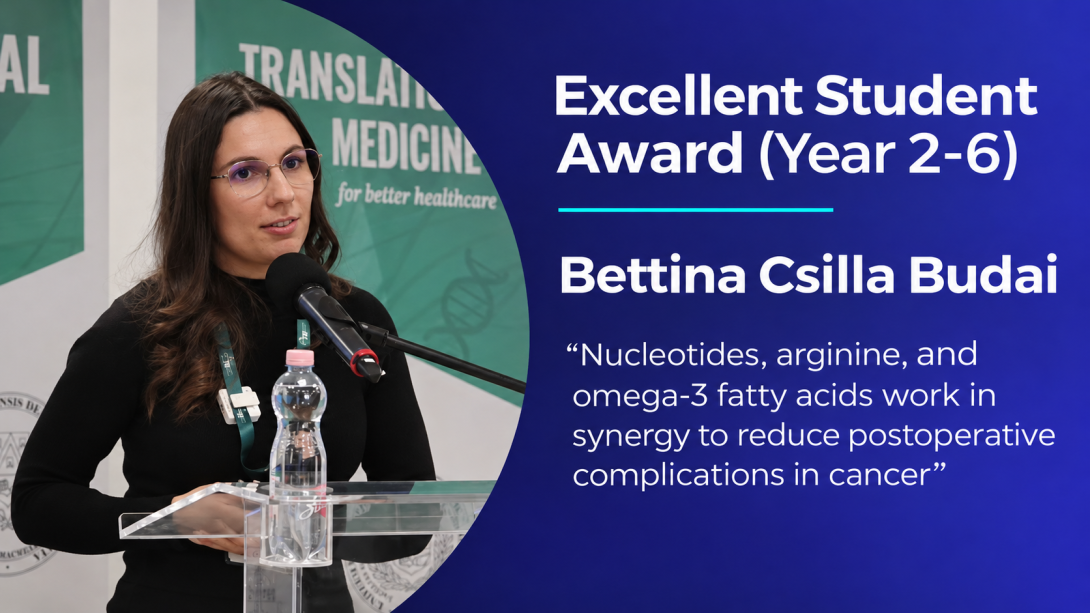
She recently published a first-author paper in a D1 journal, which revealed that immunonutrition can reduce postoperative complications in gastrointestinal cancer. This finding may help guide nutritional care to improve surgical recovery. Bettina Csilla Budai was honored with the Excellent Student Award by the Centre for Translational Medicine.
Bettina Csilla Budai is a clinical dietitian and a fifth-year Ph.D. student in the CTM program. She began her career at the Center of Excellence for Pancreatic Diseases, Semmelweis University, where she gained clinical experience. For the past two years, she has been working as an assistant lecturer at the university’s Faculty of Health Sciences, in the Department of Dietetics and Nutritional Science. Currently, she is on maternity leave at home with her baby, but she has not put her Ph.D. research on hold. “My interest in research was sparked when I began working as a dietitian at the Center of Excellence for Pancreatic Diseases. I wanted to conduct research that could directly contribute to patient care, so I was delighted to learn about the Center’s Ph.D. program. I believed this was important because, although the work of a dietitian differs from that of a physician, we also play a significant role in patient care. My research question stemmed from the recognition that patients’ nutritional status significantly impacts the outcomes of malignant diseases. Poor nutritional status has been associated with increased postoperative morbidity and mortality. After reading research on immunonutrition, I was curious to find out whether it could help improve patients’ recovery.”
Immunonutrition Support (IMNS) is a specialized medical nutrition therapy that uses specific, high-dose nutrients to promote the body's immune system. While standard nutrition support focuses on providing baseline or elevated calories, protein, and vitamins to prevent malnutrition, immunonutrition goes a step further by targeting cellular and inflammatory pathways to help the body recover from severe physical stress. The supplements used in this therapy may contain substances such as nucleotides, arginine, glutamine, omega-3 fatty acids, vitamins, and minerals, and are commonly administered orally or enterally. They show promising results in the perioperative management of cancer patients. “I was primarily interested in determining for which types of cancer immunonutrition could be beneficial and how it should be administered. I was also curious about the mechanisms through which this type of support might be helpful. My research, recently published in Advances in Nutrition, investigated whether immunonutrition reduces postoperative complications in patients with gastrointestinal cancer.”
Bettina’s meta-analysis revealed that while IMNS does not necessarily reduce in-hospital mortality or short- and long-term mortality in patients with gastrointestinal cancer, it significantly reduced postoperative complications such as infections and anastomotic leakage. IMNS also reduces the length of hospital stay by an average of two days. “The beneficial effects of immunonutrition are primarily because these nutrients are able to reduce the body’s inflammatory responses. This is something that standard nutritional support cannot achieve, it can only improve nutritional status. Although that is helpful in preoperative preparation, it may not be as effective as when nutritional supplements contain nucleotides, arginine, and omega-3 fatty acids. Interestingly, in studies that examined only the effects of omega-3 fatty acids, the results did not show a significant beneficial impact. So, nucleotides, arginine, and omega-3 fatty acids likely have a synergistic effect. To clarify this issue, we plan to contact pharmaceutical institutes and initiate clinical trials of formulas containing these ingredients.”
Bettina not only made good progress with her research, but also successfully passed her Complex Exam two years ago. She plans to defend her doctoral dissertation next spring. In addition to her current research, the doctoral thesis will include her previous study, which was published last December. In that study, she researched the risk factors for malnutrition in digestive system cancers. After earning her Ph.D., she would like to join the CTM program as a supervisor. In that role, she could assist dietitians who are interested in pursuing a doctoral degree with their research.
(Emese Szabó)