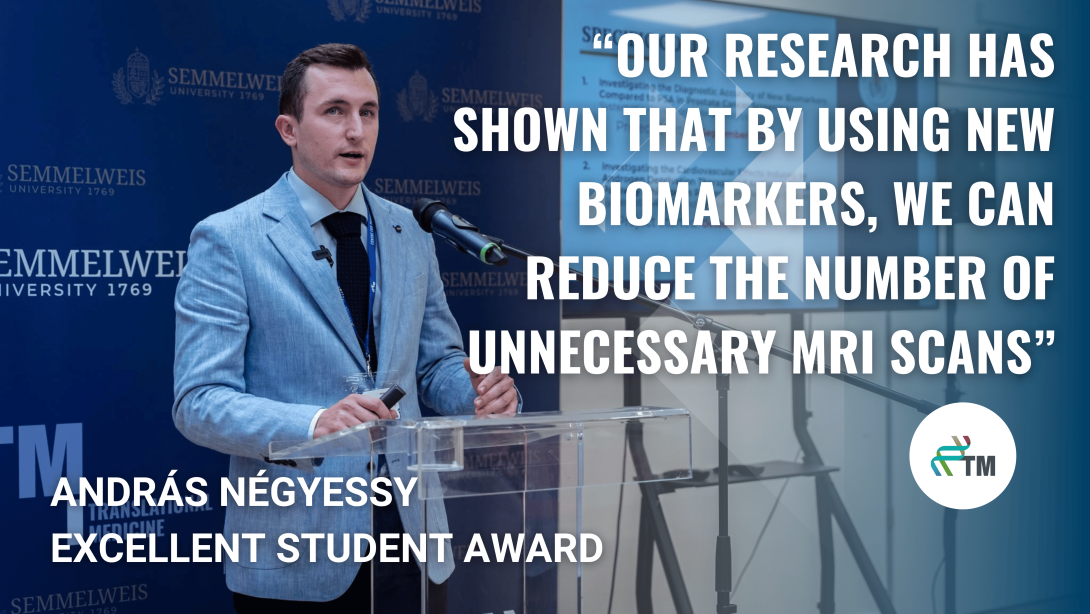
He is investigating the diagnostic accuracy of new biomarkers for prostate cancer, and the cardiovascular effects of systemic hormone therapies in patients with this malignancy. He has made significant progress in his research, and his findings could help improve the screening and treatment of prostate cancer. András Négyessy was honored with the Excellent Student Award by the Center for Translational Medicine.
Dr. Négyessy is a resident at the Department of Urology, University of Szeged, and he enrolled in CTM's training program alongside his duties there. He visits Budapest once a week to attend group meetings, and he also comes for the workshops. In addition, he works four days a week as a urology resident in Szeged and is on call four times a month. „The Ph.D. program requires many compromises, but I can work everything out and balance it with my residency. I’ll take my board exam in urology next year, so after that I’ll continue my Ph.D. studies as a specialist.”
Dr. Négyessy’s supervisor is Dr. Tamás Fazekas, who is very familiar with this program since he earned his Ph.D. degree at the Centre two years ago. He conducts research on prostate cancer, and Dr. Négyessy has also become involved in research related to this disease. „My first topic relates to prostate cancer screening. In this study, we compare the diagnostic accuracy of new biomarkers to that of PSA testing. Our results show that using these new biomarkers allows us to reduce the number of unnecessary MRI scans and biopsies while maintaining the effectiveness of prostate cancer screening. For this reason, it would be beneficial if European guidelines could incorporate these new biomarkers into prostate cancer screening.”
Dr. Négyessy has already started his second project, but it is still in its early stages. „In this study, we are investigating the long-term cardiovascular effects of systemic hormone therapies used to treat prostate cancer. It is already known that androgen deprivation therapy increases the risk of cardiovascular mortality, and the question is what effect androgen receptor pathway inhibitors – which are new hormonal therapies – have on the cardiovascular system. We assume that patients using both androgen deprivation therapy and androgen receptor pathway inhibitors should be receiving closer surveillance from cardiologists.”
(Emese Szabó)