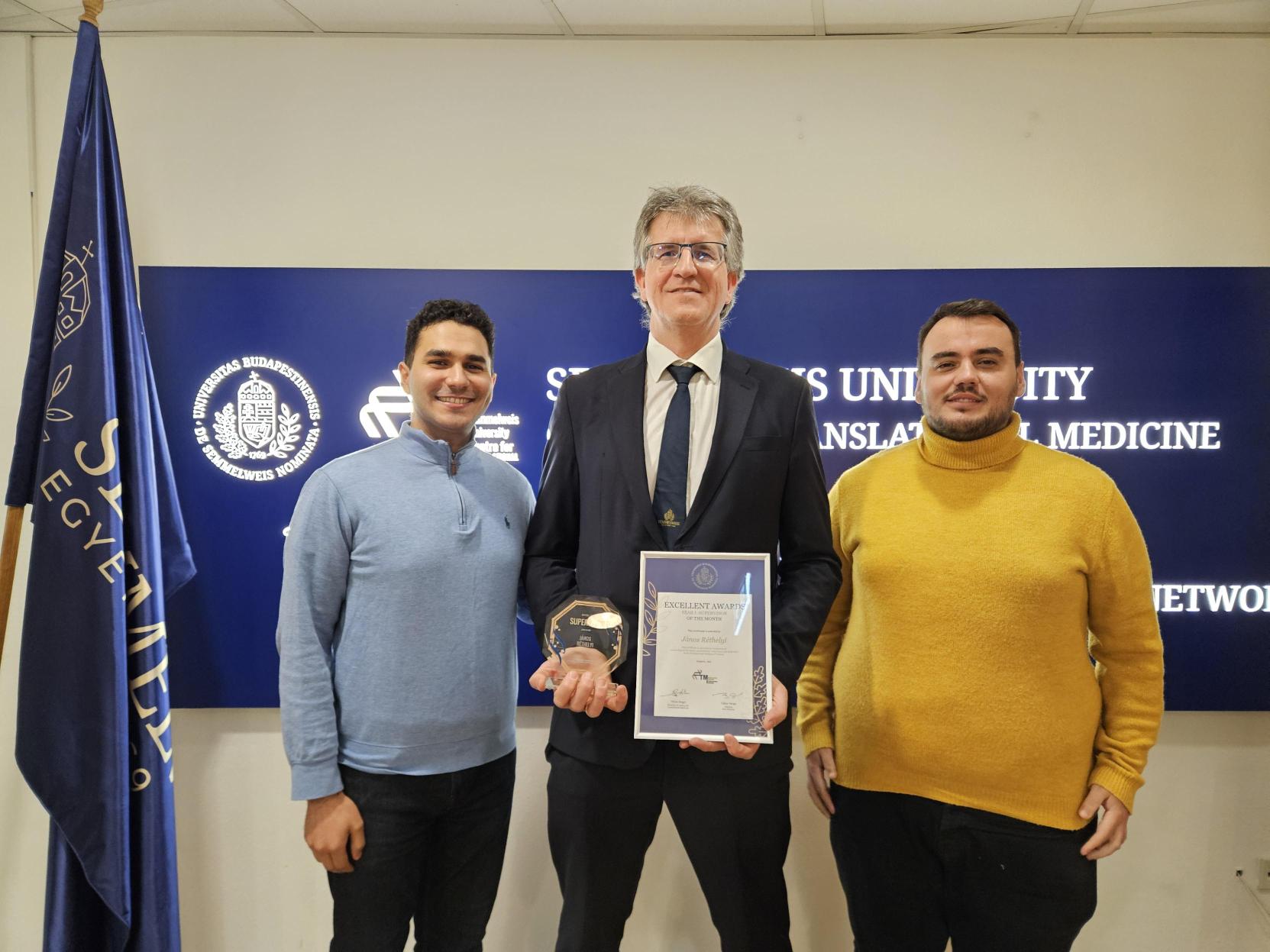
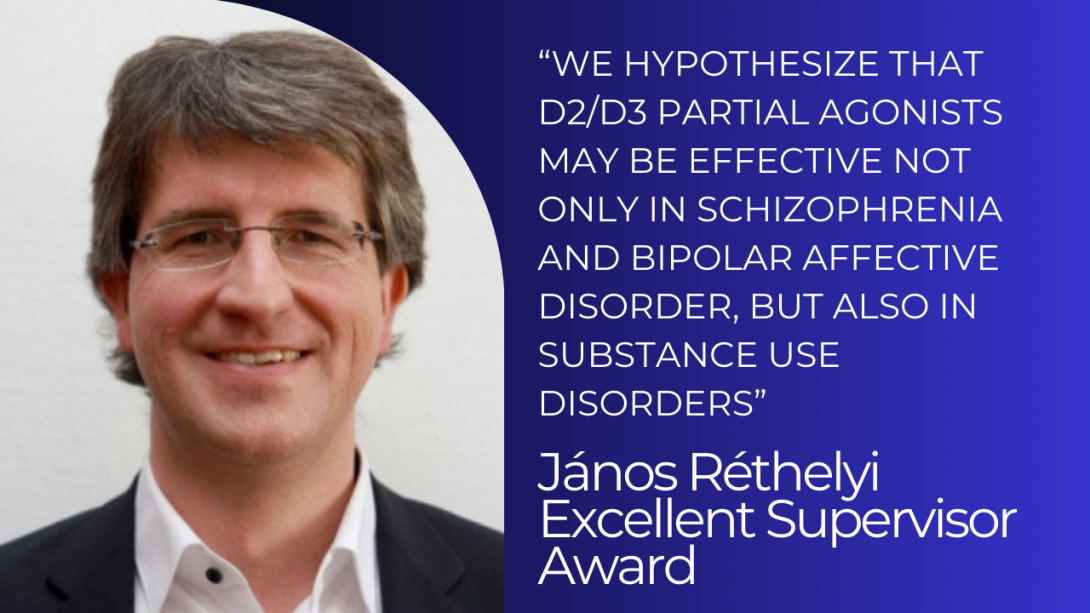
He was very active during the group meetings and provided insightful comments on many different projects. His student has made significant progress in his research, and the other student he is co-supervising is also performing well. János Réthelyi was honored with the Excellent Supervisor Award by the Centre for Translational Medicine.
János Réthelyi has been working at the Department of Psychiatry and Psychotherapy, Semmelweis University since 2003, and has served as its director for ten years. His second five-year term was recently extended, but he is currently taking a short sabbatical break because he has earned a Fulbright Scholarship. “I am about to spend six months as a visiting professor at Indiana University, which is a fantastic opportunity. I currently have two students at the Centre for Translational Medicine, and I will keep in touch with them online during this period, just as with my other Ph.D. students at the Department,” he says.
At CTM, Professor Réthelyi supports Amit Lucatz's research as a supervisor. “He is a fifth-year medical student, and when he approached me, after our first discussion I gladly agreed to help him with his research. I saw that he was really interested in psychiatry, especially pharmacological treatments, which are quite a neglected area of psychiatry. Therefore, it is an advantage that meta-analyses are well-suited to research this area. In our first project, we are investigating the role of dopamine receptor 2 and 3 (D2/D3) partial agonists in substance use disorders. Our hypothesis is that these atypical antipsychotics may also be effective in such patients. If our assumption proves to be correct, D2/D3 partial agonists could be used not only for schizophrenia, schizoaffective and bipolar affective disorder, but also for substance use disorders.”
Lucatz's second meta-analysis relates to post-traumatic stress disorder. In this project, the research group aims to compare the efficacy of different pharmacotherapies in PTSD. “This topic is particularly important because achieving good results in the treatment of PTSD remains a major challenge in psychiatry. For this reason, we believe that it is important to clarify the effectiveness of medication treatments in a network meta-analysis. In our work, we follow CTM's guidelines, and in addition to our regular meetings, we also participate in group meetings. Amit is very active, and working with him is highly effective.”
Professor Réthelyi also assists Boglárka Kertész in her research work as a co-supervisor. In her first project, she is investigating the efficacy of pharmacological and psychological interventions for adult ADHD. “Boglárka's supervisor is Xénia Goda, and I am happy to help them with their work, because I deal with such patients in my medical practice. On the other hand, we are also researching this topic at the department, so it was natural for me to join this project as a co-supervisor. Our collaboration is excellent, and Boglárka is making good progress with her research.”
(Emese Szabó)