
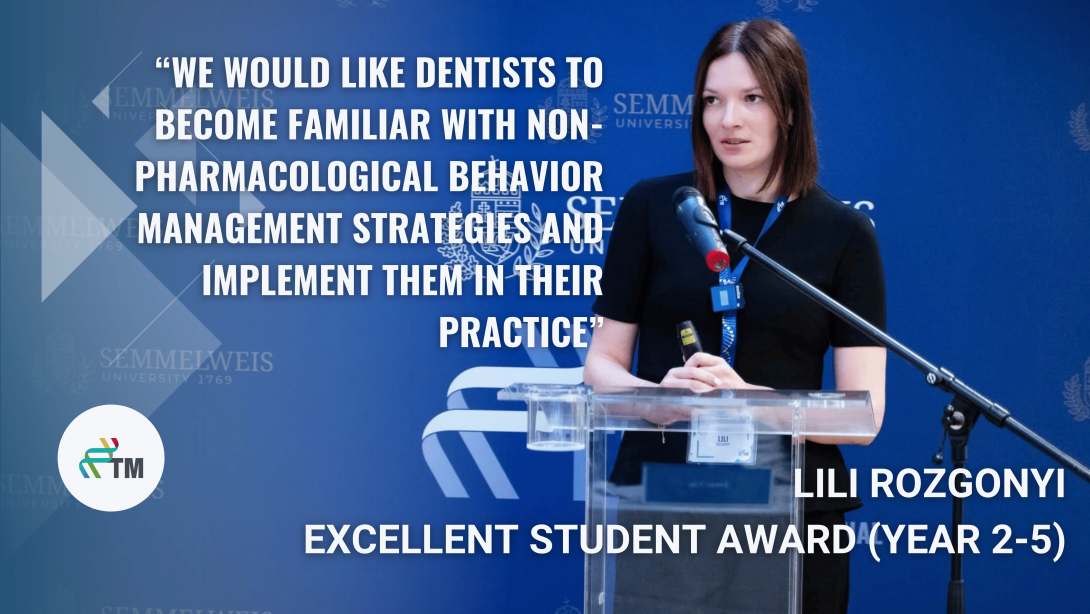
She is researching non-pharmacological interventions in dental procedures for children and adolescents with neurodevelopmental disorders, and has just published her findings on this topic in a D1 journal. Lili Rozgonyi was honored with the Excellent Student Award by the Centre for Translational Medicine.
Lili Rozgonyi works at the Department of Pediatric Dentistry and Orthodontics, Semmelweis University, and, in addition to her clinical work, joined CTM’s program three years ago. When she began her Ph.D. training, she was still a pediatric dentistry resident, but she has since passed her board exam and is now a board-certified specialist. As a part of her training at CTM, she conducts research to improve dental care for children and adolescents with special needs. In her first study, she examined the possibilities related to ADHD, autism spectrum disorder (ASD), and intellectual disabilities. “We have a team at the university that provides dental care under general anesthesia for children with neurodevelopmental disorders. This is necessary because children and adolescents with this condition often experience severe anxiety at the clinic, as well as behavioral difficulties that make routine dental care challenging. When these children visit us for examinations before treatment, it often turns out that they do not necessarily need under general anesthesia. In many cases, we find that alternative methods can be used to distract them from the discomfort associated with the examination.”
Although non-pharmacological behavior management strategies have been increasingly implemented in dental care, their effectiveness has not been comprehensively quantified. For this reason, Dr. Rozgonyi began her research to assess accurately which of the available options could actually be used and would be most effective for this purpose. “We would like dentists to become familiar with non-pharmacological behavior management strategies and implement them in their practice. Since this could eliminate the need to send children to clinics for minor procedures performed under anesthesia, it would be a great benefit to both children and their parents, as well as to the healthcare system”
Non-pharmacological behavior management techniques include a wide variety of methods, such as the sensory-adapted dental environment (SADE), distraction techniques, desensitization, and audiovisual interventions. Even providing children with VR glasses, which they can use to watch cartoons, for example, might be a useful tool. These techniques can be used during or before dental treatment. In their article, researchers pointed out that audiovisual distractions and SADE may serve as effective approaches to both improve cooperation and reduce anxiety during dental care for children and adolescents with neurodevelopmental disorders. They emphasized that clinicians should consider individualized strategies and that further research is needed to provide guidance on dental care protocols for this vulnerable population in everyday practice. Dr. Rozgonyi has already begun her second project, in which she is researching the effectiveness of visual oral health education techniques for children with hearing impairments. This topic is important because a significant proportion of children with hearing impairments is unable to brush their teeth properly. If this situation could be improved, dental problems would be easier to prevent for them as well.
(Emese Szabó)