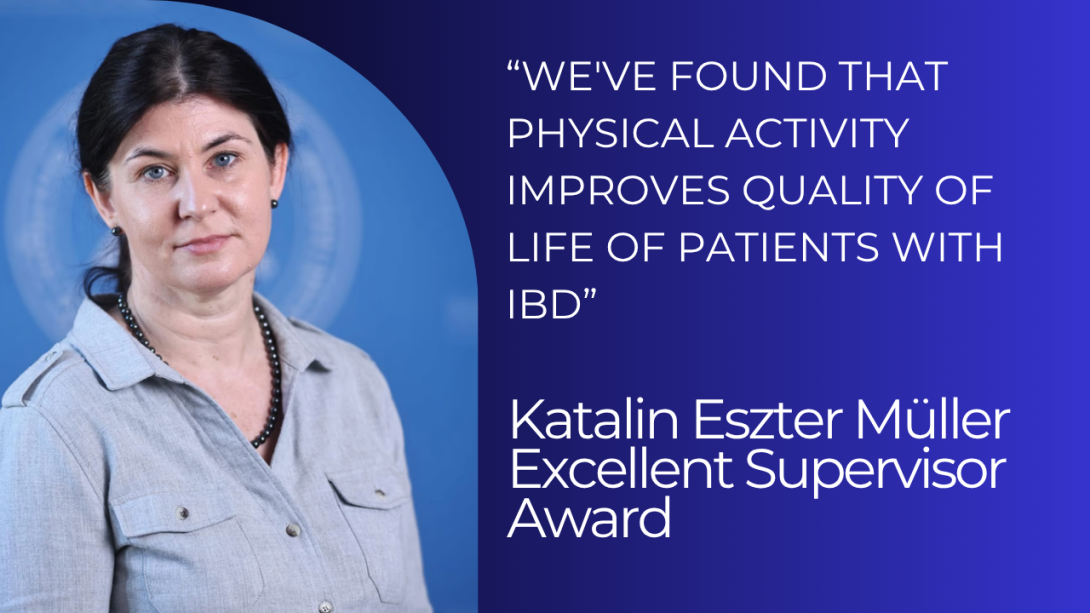
She works as a chief physician in pediatrics and pediatric gastroenterology at the Heim Pál National Pediatric Institute, and in addition to her clinical work, she participates in the CTM training program as a supervisor. She enthusiastically supports the scientific work of young doctors. One of them recently published her research in a D1 journal, and her findings could help improve the quality of life for patients with IBD. Katalin Eszter Müller was honored with the Excellent Student Award by the Centre for Translational Medicine.
Dr. Müller is an outstanding supervisor in the Pediatrics Group, where she assists several students with their research. One of them is Emese Kasznár, a third-year Ph.D. student who recently published a high-quality article in a D1 journal. The research demonstrated that physical activity improves the quality of life of patients with inflammatory bowel disease (IBD). “Emese is a resident physician at our institute, so we see each other not just at meetings, but during our clinical work as well. The idea for our research came from the fact that we knew: reduced muscle mass worsens the outcome of IBD. In practice, this means that affected patients are more likely to need surgery, biologic therapies, and hospitalization. We were interested in whether physical activity could change this scenario. Our research question was whether increasing patients’ muscle mass through exercise would improve their condition. It is important to note that in inflammatory bowel disease, patients’ muscle mass decreases not only due to a lack of exercise but also because the ongoing inflammatory process itself reduces muscle mass. This phenomenon is similar to what can occur in cancer patients.”
From the academic literature, researchers knew that people with inflammatory bowel disease generally get less exercise. “The reason for this is complex. It is partly because people with diarrhea don’t feel like going to the gym, and they typically have less energy. Those affected also try to avoid physical activity due to the pain associated with intestinal inflammation. When IBD occurs in children, it is also common for parents to try to shield them from everything, and as a result, they are reluctant to encourage them to do sports. That is why we wanted to clarify whether it is beneficial to increase muscle mass through personalized physical activity. Because if it is, then those involved need to change their mindset and let their unnecessary fears go in order to improve conditions.”
It has long been known that recreational sports have countless health benefits. For example, it triggers the release of endorphins, which improves people’s mood, and also releases anti-inflammatory substances. For this reason, it can be assumed that for those who regularly walk, run, do yoga, or engage in other forms of exercise, these anti-inflammatory molecules can help reduce any inflammation that may be present. “In our meta-analysis, we wanted to clarify how physical activity affects patients’ quality of life and disease activity. We were also interested in changes in body composition, particularly the increase in muscle mass and changes in handgrip strength. Our research has clearly demonstrated an increase in muscle strength and an improvement in quality of life, so we now know that it makes sense to recommend exercise to patients. We did not find a significant reduction in disease activity, but this may be partly due to the fact that the available studies we analyzed included patients whose disease activity was already low. Therefore, it is important to note that, although not significantly, we observed a slight decrease in the levels of inflammatory markers and fecal calprotectin in the patients.”
Dr. Müller and Dr. Kasznár also have a study about to be published, in which they examined the level of physical activity of IBD patients. This was assessed, among other factors, by analyzing the number of steps taken each day. They also examined how closely patients monitor their diets and how much ultra-processed food they consume. They also conducted research in which they measured the grip strength, physical activity, and body composition of their own pediatric IBD patients. This study showed that these children engaged in less physical activity than healthy children and had lower muscle mass. Their grip strength also lagged behind that of other children. This is the case even when their disease is in remission.
(Emese Szabó)