
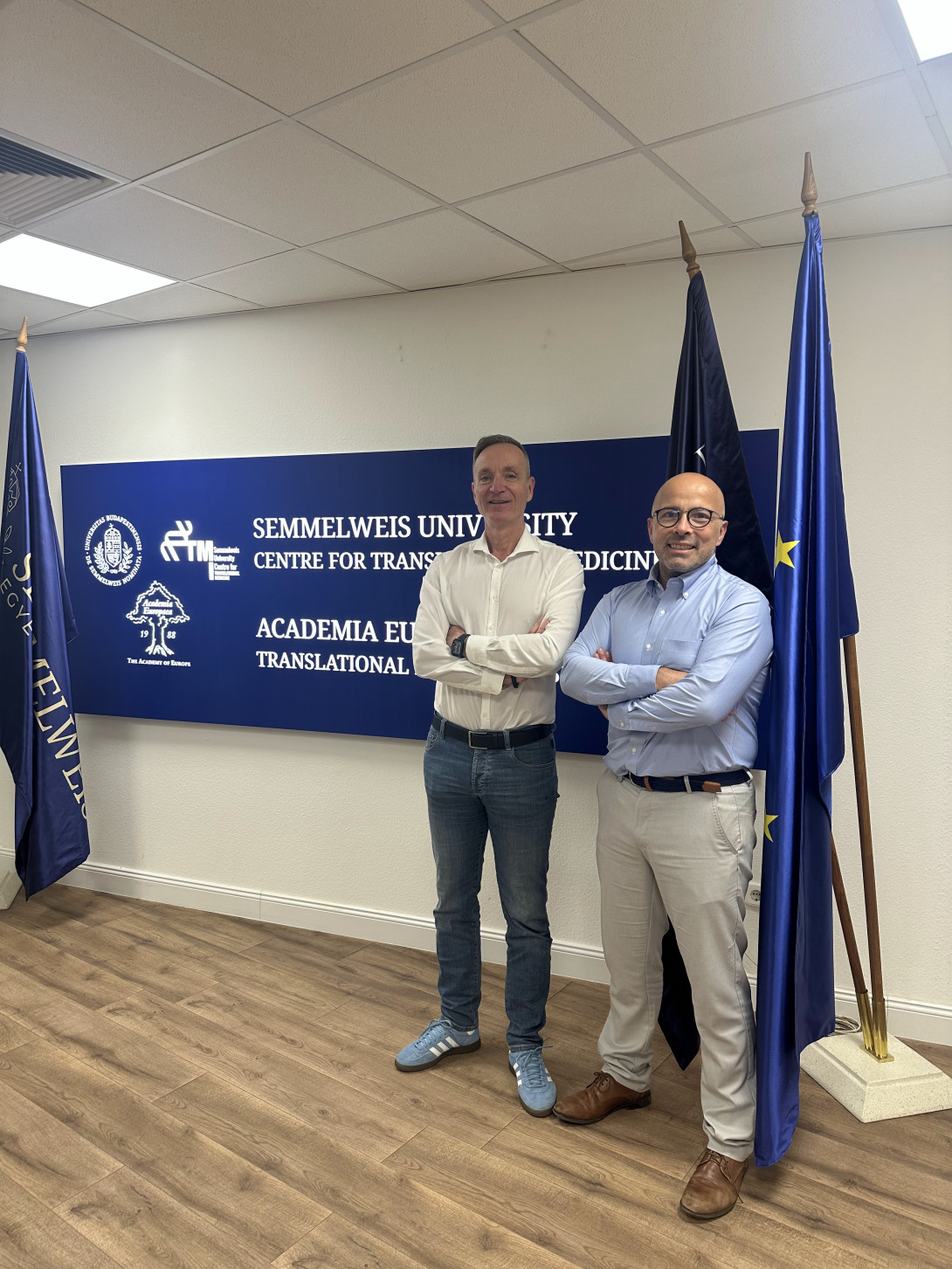
More than twenty years have passed since Hungary last witnessed an international success of this magnitude in the field of obstetrics and gynecology. In recent years, the research performance of the Department of Obstetrics and Gynecology at Semmelweis University has shown remarkable growth: according to the Semmelweis Publication Database of the Central Library, the number of scientific publications has nearly tripled over the past five years. Moreover, the progress has been outstanding not only quantitatively but also qualitatively: the number of first- and last-author publications has tripled, while the number of top-ranked D1 publications has increased fivefold. All this indicates that the department has now become an active contributor to international obstetrics and gynecology research.
One of the most important pieces of evidence of this scientific breakthrough is that researchers from the department have published six papers in the American Journal of Obstetrics and Gynecology (AJOG) over the past five years, one of the most prestigious journals in the world in this field. According to the SCImago Journal Rank (SJR), it currently ranks 3rd in the obstetrics and gynecology category and has an impact factor of 8.4. Such a strong presence from a Hungarian research group has not been seen for more than twenty years. According to professional retrospectives, the last similarly significant Hungarian publication success of international relevance was achieved in 2004 and was associated with Endre Czeizel. The fact that six AJOG publications by researchers from Semmelweis University have appeared within such a short period is remarkable even on an international level.
These recent publication achievements represent an important milestone not only for the department but also for Hungarian medical science as a whole. The publications contribute to strengthening the international scientific presence of Semmelweis University and pave the way for new research collaborations. The department’s achievements clearly demonstrate that Hungarian scientific institutions, with the appropriate professional background, international network, and strategic development, are capable of achieving world-class results. Furthermore, the significance of these studies extends beyond publication metrics: in the long term, they may also contribute to the advancement of gynecological and obstetric patient care.
But what lies behind these outstanding results, and how did the Semmelweis University department become an increasingly visible player in the international scientific arena? We asked Prof. Dr. Nándor Ács about these questions.
What does it mean professionally and internationally that six of your papers have been published in the American Journal of Obstetrics and Gynecology over the past five years?
We are proud because this has never happened before, neither in the history of our department nor in the history of other Hungarian obstetrics and gynecology departments. This journal is perhaps the most respected scientific journal in obstetrics and gynecology worldwide. The fact that our department’s scientific community has managed to publish so many papers in this journal represents, in my opinion, extremely serious international recognition.
How significant are these results?
In itself, it means that these studies undoubtedly have scientific relevance for the international community as well. According to the judgment of the international scientific community, these are substantial scientific achievements. Such results are considered rare in Hungarian obstetrics and gynecology.
What does the fivefold increase in D1 publications reveal about the department’s scientific development and international competitiveness?
A few years ago, we embarked on a very deliberate development strategy to elevate the department’s scientific performance to a completely different level from where it had previously been. We admitted significantly more PhD students, and the publication activity expected from these PhD students was held to much higher standards than before. Within the organization, it became absolutely clear that we always strive to publish in D1 journals, and in the vast majority of cases we succeed.
In your opinion, what has enabled the Department of Obstetrics and Gynecology at Semmelweis University to achieve such remarkable scientific progress in such a short time?
Obviously, there are several contributing factors. One is that we had committed PhD students who worked enthusiastically and at a very high standard. Naturally, it also required the department leadership’s decision to place a strong emphasis on research and high-quality publications. I would definitely add, especially in this environment, that the highly professional scientific analytical methodology and publication support technology provided by the Translational Medicine Center represented incredible assistance for us. We had the appropriate scientific topics, the right supervisors, and excellent young colleagues, but the extraordinary level of organization at the Translational Medicine Center was an enormous help.
It has been more than twenty years since Hungary last achieved a similar success in this field. How do you evaluate its historical significance?
We are truly very proud of this. I believe it is also a tremendous step forward for Hungary. Within Hungary, I think it was the Department of Obstetrics and Gynecology at Semmelweis University that managed to achieve this. It is an enormous accomplishment when we consider that Hungary had not succeeded in publishing in the world’s leading obstetrics and gynecology publication platform for twenty years. Now, Semmelweis University has published such a number of papers in recent years. I genuinely believe this could represent a breakthrough toward the international research community.
How can high-level patient care and world-class scientific work be carried out simultaneously?
At a university clinic, especially at a European university clinic, this is certainly a fundamental requirement. What makes us different from a hospital department is that, on the one hand, professional care — including obstetrics and gynecology care — must represent the highest standard in Hungary. Today, it is also essential for a university clinic to produce appropriate scientific performance alongside this. This requires much greater investment of energy and time from my colleagues than is typically necessary in less prominent institutions.
Could you highlight a few of the professional achievements?
Several professional achievements could be highlighted. One example is our analysis concerning maternal age, in which, using a very extensive dataset, we were able to demonstrate that maternal age is associated with the risk of developmental abnormalities. Thus, both pregnancies occurring at a very young age and pregnancies undertaken at an advanced maternal age can significantly increase the risk of developmental disorders. Therefore, prenatal care and screening must also be adapted accordingly for these mothers. (Both very young maternal age and maternal age above 40 increase the risk of certain congenital developmental abnormalities, which is why age-adjusted prenatal care is necessary.)
Another significant result was that alterations in the vaginal flora, as well as the presence of certain pathogens in the vagina, showed a strong association with a higher risk of preterm birth and low birth weight. There had previously been assumptions about this, but we succeeded in proving it in a way that the American Journal accepted and published. (Certain bacteria present in the vagina are associated with a higher risk of preterm birth and low birth weight.)
We also published findings on genetic testing, specifically on cases where genetic abnormalities are identified from a blood sample taken from the mother. What was particularly interesting was that further examination of these samples also revealed that the detected abnormalities may indicate not only fetal genetic conditions but also previously unknown maternal cancers or an elevated risk of such diseases. (Modern fetal genetic tests performed from maternal blood samples may, although rarely, draw attention not only to pregnancy complications but also to hidden maternal cancers.)
Since 2021, the department has been an active participant in the Translational Medicine Training Program, and more than 50 students have joined so far. How important is such a structured scientific environment in the development of young researchers?
The emergence of the center represented enormous support for us. The Department of Obstetrics and Gynecology has access to a very large patient population, and as a result we have a great deal of analyzable data. We have talented young colleagues who were able to join this community and these processes as researchers. We also have excellent supervisors, among the leading experts in the country. However, until now, this level of organized structure and system had not been available at our department. This kind of scientific background, provided by the Translational Medicine Center, was an incredible support for us.
What role does the involvement of young doctors and PhD students play in producing publications of such a high standard?
It is clear that our young colleagues are the ones who possess scientific curiosity and enthusiasm. Since they wish to achieve significant career advancement at the university, they are also under a certain level of performance pressure to demonstrate serious scientific achievements. As a result, there are many highly talented young professionals at the department. We provided them with support and guidance, led them through this process, and this is how we arrived where we are today.
In your opinion, what message do these achievements convey to the international scientific community about Hungarian obstetrics and gynecology research?
They convey that Hungarian obstetrics and gynecology research is at least on the same level as the obstetrics and gynecology research activities of other European countries. We can say that previously the organization and operation of Hungarian obstetrics and gynecology were different overall. Up until about 15 years ago, there was less focus on scientific publications and scientific analyses. Now, however, a very significant transformation has taken place, and we have clearly joined the European forefront.
What message would you give to young doctors and researchers who would like to become involved in the scientific work of Semmelweis University and achieve internationally significant results?
Those young people who have not yet started should begin. They should seek out the right supervisors in whom they can place their trust, and together they should select one or several strong research topics. Semmelweis University provides the full infrastructure necessary to achieve such scientific results, even at a very young age.
Cooperation has begun with the Vienna Women’s Clinic. Where could this collaboration between the two universities lead? It is already known that there are 12 joint studies between the two universities.
When we mention the name Semmelweis, two locations are associated with his work: Vienna and Budapest. Building on this historical connection, we are very pleased about the collaboration that has developed with the Vienna University Clinic. Joint research projects are underway; the Viennese colleagues participate in our projects, and we participate in theirs. We expect this to become an extremely fruitful collaboration in the coming years.
The articles referenced in the interview are available here: