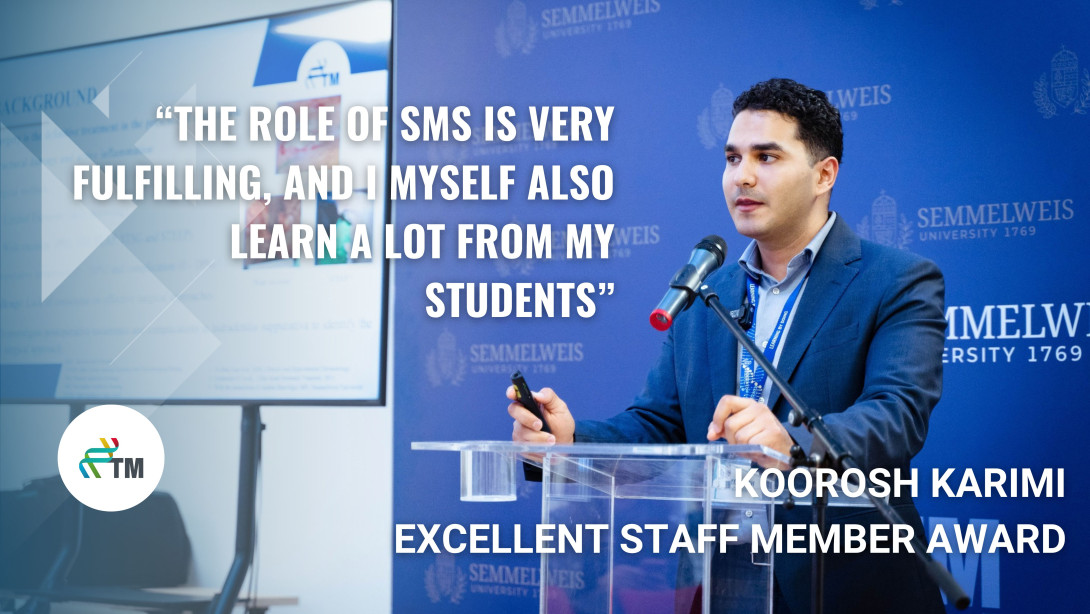
He is very creative and has excellent organizational skills, and has greatly helped to build the SMS community. He is also making excellent progress with his own projects, investigating treatments for the skin disease Hidradenitis Suppurativa. Koorosh Karimi was honored with the Excellent Staff Member Award by the Centre for Translational Medicine.
Dr. Karimi started working as a Scientific Methodology Supervisor at the Centre for Translational Medicine this academic year. He currently mentors nine students from several fields, including dermatology, psychiatry, otolaryngology, ophthalmology, oncology, and physiotherapy. “The role of SMS is very fulfilling, and I myself also learn a lot from my students,” he notes. His own field is dermatology, which caught his interest during his medical studies.
“During my dermatology block, I realized that dermatology brings together everything I enjoy in medicine: internal medicine, surgery, microbiology, and long-term patient care. Another thing I find very exciting about dermatology is that the skin is like the ‘showroom of the body’. Many internal diseases reveal themselves through the skin, and even emotional states such as stress can immediately worsen skin conditions. At the same time, skin diseases cannot be hidden. These problems often affect a patient’s confidence, social life, and mental well-being in a very direct way,” he highlights.
Dr. Karimi started his research work as a medical student. “As a TDK student, Dr. András Bánvölgyi and Dr. Lőrincz Kende were my supervisors, and when I told them about my interest in pursuing a Ph.D., they recommended the CTM program. After attending the introductory lecture, I was truly impressed by how well-structured and supportive the program was.” When Dr. Karimi started his Ph.D. training last year, he defined a clear vision for himself: to improve the quality of life of patients living with Hidradenitis Suppurativa (HS). People affected by this disease carry a very heavy physical and emotional burden, and he wanted to make their lives easier with his research work.
In his first project, he is investigating the safety and efficacy of surgical management in HS to help reduce the risk of complications and recurrence, to speed up recovery, and to improve the patients' quality of life. His preliminary findings are promising and may help clinicians select safer and more effective surgical strategies for HS. In his second project, he is evaluating the safety and efficacy of GLP-1 receptor agonists in HS. This project examines how GLP-1 therapy, especially in obese or type 2 diabetes mellitus HS patients, affects disease severity, metabolic markers, inflammation, and overall quality of life. His preliminary findings indicate meaningful improvements, suggesting a potential new therapeutic option for a patient group that currently has very limited treatment choices.
In addition to his own Ph.D. projects, Dr. Karimi also works as a co-investigator on other research studies. He is currently involved in projects with Bella Anna Kelemen and Lili Gulyás. “Bella has recently submitted her manuscript, and we are now actively working on Lili’s project. Being part of these collaborations allows me to contribute more broadly and gain valuable experience from different research perspectives within dermatology.”
(Emese Szabó)